




CBD alters the metabolism of many veterinary drugs by blocking key liver enzymes, potentially exposing animals to serious adverse effects. This phenomenon, known as enzyme-mediated drug interaction, affects CBD-drug interactions in dogs, cats, and other species. As of 2026, no CBD-based veterinary drug has marketing authorization in France. Understanding the mechanisms involved, the drug classes affected, and the necessary precautions is essential before administering CBD to an animal undergoing treatment.
Which veterinary drugs interact with CBD?
CBD inhibits several cytochrome P450 enzymes, including CYP3A4, CYP2C9, and CYP2C19, which are involved in the metabolism of approximately 60% of medications. Specifically, when these enzymes are blocked, the liver metabolizes medications in the bloodstream more slowly. As a result, the concentration of these substances increases, sometimes reaching toxic levels.
CBD can increase the blood concentration of certain medications by a factor of two to five. This is not a trivial variation: a doubled dose of an anti-epileptic drug in the blood can cause profound sedation or neurological disorders. The interaction is not always in the direction of an increase. CBD also sometimes acts as a metabolic modulator, accelerating the breakdown of certain molecules and reducing their effectiveness.
Drug classes to monitor
The therapeutic classes most exposed to interactions with CBD are as follows:
- Antiepileptic drugs (phenobarbital, potassium bromide): risk of accumulation and excessive sedation
- Anticoagulants (warfarin): increased risk of bleeding if the concentration increases
- Non-steroidal anti-inflammatory drugs (NSAIDs) (meloxicam, carprofen): potentiation of gastrointestinal and renal effects
- Anxiolytics and sedatives (diazepam, trazodone): increased sedation, risk of respiratory depression
- Antibiotics and antifungals metabolized by CYP3A4: reduced efficacy or increased toxicity depending on the direction of the interaction
- Corticosteroids (prednisolone): possible modification of the duration of action
| Drug family | Main risk | Alert level |
|---|---|---|
| Antiepileptics | Overdose, deep sedation | Pupil |
| Anticoagulants | Hemorrhage | Pupil |
| NSAID | Digestive and renal toxicity | Moderate to high |
| Anxiolytics / sedatives | Depression of the nervous system | Moderate |
| Antibiotics (CYP3A4) | Loss of effectiveness or toxicity | Variable |
| Corticosteroids | Modified duration of action | Moderate |
The list of drug interactions to watch out for with CBD is longer than most pet owners realize. Consulting a veterinarian before any combination remains the only way to assess the actual risk to a given animal.
What side effects can CBD cause in animals?
Common side effects of CBD in animals include drowsiness, digestive upset (nausea, diarrhea), dry mouth, and a temporary drop in blood pressure. These signs appear mainly at the beginning of treatment or when the dose is increased too quickly. They are generally reversible when CBD is discontinued.
Severe symptoms are less frequent but require immediate attention. Severe lethargy, tremors, urinary incontinence, or impaired coordination should prompt an emergency veterinary consultation. These signs often indicate an active drug interaction or an overdose.
Symptoms to monitor on a daily basis
Here are the clinical signs to observe in an animal receiving CBD alongside veterinary treatment:
- Unusual drowsiness or difficulty getting up
- Persistent vomiting or diarrhea
- Loss of appetite lasting more than 24 hours
- Tremors or convulsions
- Disorientation, loss of balance
- Slow or difficult breathing
- Sudden urinary or fecal incontinence
The side effects of CBD vary depending on the species, weight, dose, and other medications being used. A dog on phenobarbital that receives CBD without dose adjustment may experience dangerous sedation within just a few hours.
Pro tip: Keep a daily log of your pet's behavior from the first day of CBD administration. Note the time, dose, medications taken, and any changes in behavior. This document will be invaluable to your veterinarian.
How to use CBD safely with veterinary medicines?
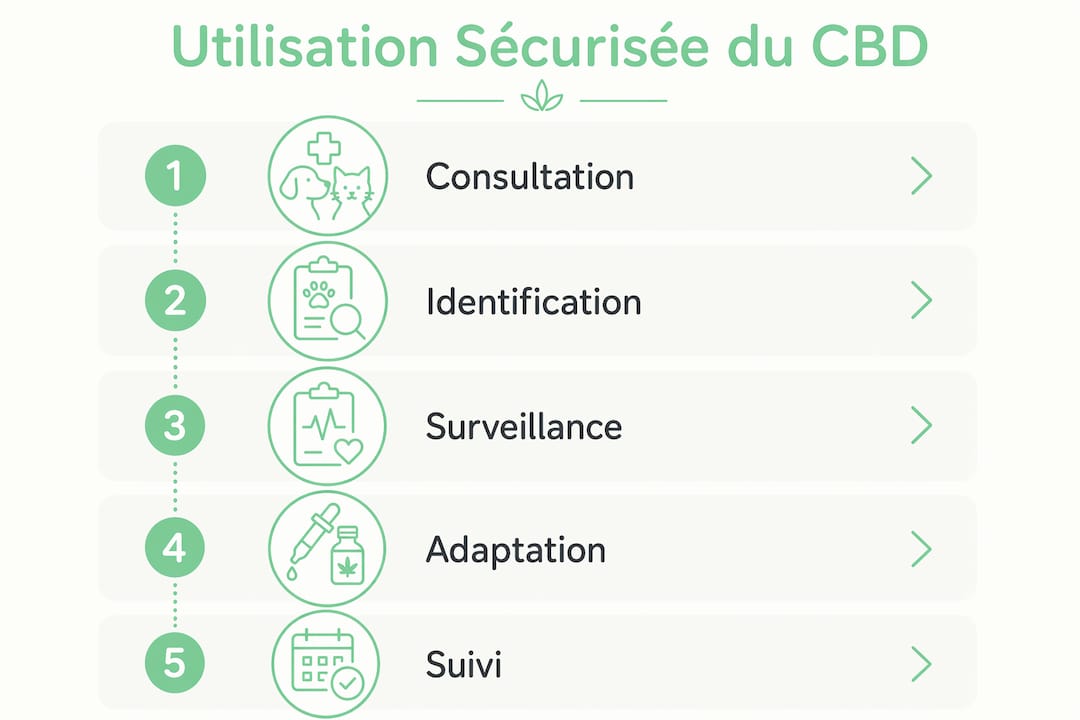
Safety rests on four non-negotiable principles: prior consultation, low initial dose, spacing of doses, and selection of a suitable product. None of these principles can be circumvented without increasing the risk to the animal.
-
Consult your veterinarian first. The veterinarian will assess your current treatments, identify any potential interactions, and adjust the dosage if necessary. This step is mandatory, not optional.
-
Start with a low dose. The recommended initial dose is between 0.1 and 0.5 mg/kg per administration. A gradual increase over several weeks allows observation of the animal's tolerance before reaching the target dose.
-
Leave at least 2 hours between doses. Administering CBD and other medications at least 2 hours apart reduces the risk of enzyme interference in the liver. This interval allows the liver time to process each substance separately.
-
Choose a product certified for animals. The product must have a Certificate of Analysis (COA) confirming the absence of THC, xylitol, pesticides, and heavy metals. Products formulated for humans are not suitable for animals.
-
Monitor and adjust. After each dose change, observe the animal for 48 to 72 hours. If any unusual signs appear, contact your veterinarian immediately.
Pro tip: Bring the label and Certificate of Analysis (COA) of the CBD product to your veterinarian during the consultation. This allows them to verify the exact composition and tailor their advice accordingly.
For dogs, a CBD oil administration guide details practical methods to facilitate intake and avoid dosage errors.
What precautions should be taken depending on the species and the pathology?
Dogs and cats do not metabolize CBD in the same way. This difference drastically changes the level of risk depending on the species.
Dogs: sensitivity to THC and antiepileptics
Dogs have a high density of CB1 receptors in their brains. THC toxicity is therefore particularly pronounced in dogs, with serious neurotoxic effects even at low doses: ataxia, seizures, and hypersalivation. A poorly controlled CBD product containing traces of THC poses a real danger to a dog. Dogs taking phenobarbital or potassium bromide are doubly at risk, as CBD can increase the blood concentration of these antiepileptic drugs.
Cats: limited liver metabolism
Cats have a reduced capacity for glucuronidation, which slows their elimination of many substances. CBD remains active in their system for longer. This characteristic makes cats more susceptible to cumulative effects and prolonged drug interactions. Doses should be even lower than in dogs, and the intervals between doses longer.
High-risk clinical situations
Certain medical conditions increase the level of risk when combining CBD and veterinary medications:
- Treated epilepsy : CBD may alter the concentration of antiepileptic drugs and cause seizures or excessive sedation.
- Cardiovascular diseases : the blood pressure reduction induced by CBD adds to the effects of cardiac treatments
- Liver failure : the already weakened liver metabolizes the two substances even less efficiently simultaneously
- Anticoagulant treatments : the risk of bleeding increases if the concentration of the anticoagulant rises
Horse owners must also consider the specific pharmacological characteristics of their species. A dedicated page on the use of CBD in horses discusses these particularities in detail.
Pet owners often underestimate the dangers of products that are unsuitable for animals and lack quality control. A certificate of analysis is not a mere administrative detail. It is the only guarantee that the product does not contain substances toxic to the animal.
Key points
CBD interacts with veterinary drugs via cytochrome P450 inhibition, which necessitates prior veterinary consultation, gradual dosage, and the selection of a product certified as THC-free.
| Point | Details |
|---|---|
| Enzyme inhibition | CBD blocks the CYP3A4, CYP2C9 and CYP2C19 enzymes, altering the concentration of many medications. |
| High-risk families | Antiepileptics, anticoagulants and NSAIDs present the most dangerous interactions with CBD. |
| Gradual dosage | Starting between 0.1 and 0.5 mg/kg and spacing doses at least 2 hours apart limits liver interference. |
| Species and sensitivities | Dogs are very sensitive to THC; cats metabolize CBD more slowly, increasing the cumulative risk. |
| Mandatory certificate of analysis | Only a verified COA guarantees the absence of THC, xylitol and contaminants in the product administered to the animal. |
What I observe in practice regarding the interactions between CBD and veterinary medications
Most of the problems I encounter don't stem from CBD itself. They come from a lack of communication between the owner and the veterinarian. People buy a CBD product for their dog while it's on phenobarbital, thinking they're doing the right thing, and don't mention it at the next appointment. The veterinarian observes unusual sedation, increases the phenobarbital dose, and the problem worsens.
What also strikes me is the persistent confusion between human and animal products. One out of every two pet owners I meet uses CBD oil they bought for themselves. These products can contain xylitol, a sweetener that is deadly for dogs, or CBD concentrations that are unsuitable for an animal's weight. The Certificate of Analysis (COA) is not just a formality. It's the document that separates a safe product from a potentially dangerous one.
I am also convinced that caution in 2026 is more justified than ever. Research on veterinary CBD is progressing, but the data remains insufficient to establish standardized protocols. The lack of veterinary marketing authorization in France is not a regulatory detail. It reflects a lack of robust clinical evidence. This does not mean that CBD is useless for animals. It means that each case must be treated individually, with a veterinarian involved from the outset.
My most direct advice: if your pet is on medication, don't start CBD without consulting your veterinarian. And if your vet isn't familiar with it, find one who is. Integrative veterinary medicine exists and is evolving.
— Daniel
Lord Of CBD and animal safety: what you need to know
Choosing a CBD product for your pet isn't just about comparing prices. The quality of the product directly determines the animal's safety.
Lord Of CBD offers a selection of CBD products made from organic hemp, with a THC content of less than 0.3% and certificates of analysis available for each product. These guarantees are essential for any pet owner wishing to combine CBD with an existing veterinary treatment. premium CBD products meet the purity criteria recommended by veterinarians: absence of contaminants, controlled formulation, and complete traceability. Before administering any product, consult your veterinarian and provide them with the Certificate of Analysis (COA) for your chosen product.
Frequently Asked Questions
Is CBD dangerous for an animal undergoing treatment?
CBD can be dangerous if administered without prior veterinary consultation. It alters the blood concentration of many medications by inhibiting cytochrome P450 enzymes, which can cause toxic effects or reduce the effectiveness of the treatment.
Which veterinary drugs interact most with CBD?
Antiepileptics, anticoagulants, and NSAIDs have the most documented interactions with CBD. These combinations can increase the blood concentration of the drug in question by a factor of 2 to 5.
What dose of CBD is safe for an animal on medication?
The recommended starting dose is 0.1 to 0.5 mg/kg per dose, with a gradual increase under veterinary supervision. A minimum of 2 hours between CBD and other medications reduces the risk of liver interference.
Do cats react differently to CBD than dogs?
Yes. Cats metabolize CBD more slowly than dogs due to reduced liver capacity. Therefore, they are more susceptible to cumulative effects and require lower doses and longer intervals between administrations.
How to choose a safe CBD product for your pet?
Choose a product with a Certificate of Analysis (COA) confirming the absence of THC, xylitol, pesticides, and heavy metals. Products formulated for humans are not suitable for animals and may contain substances toxic to them.