



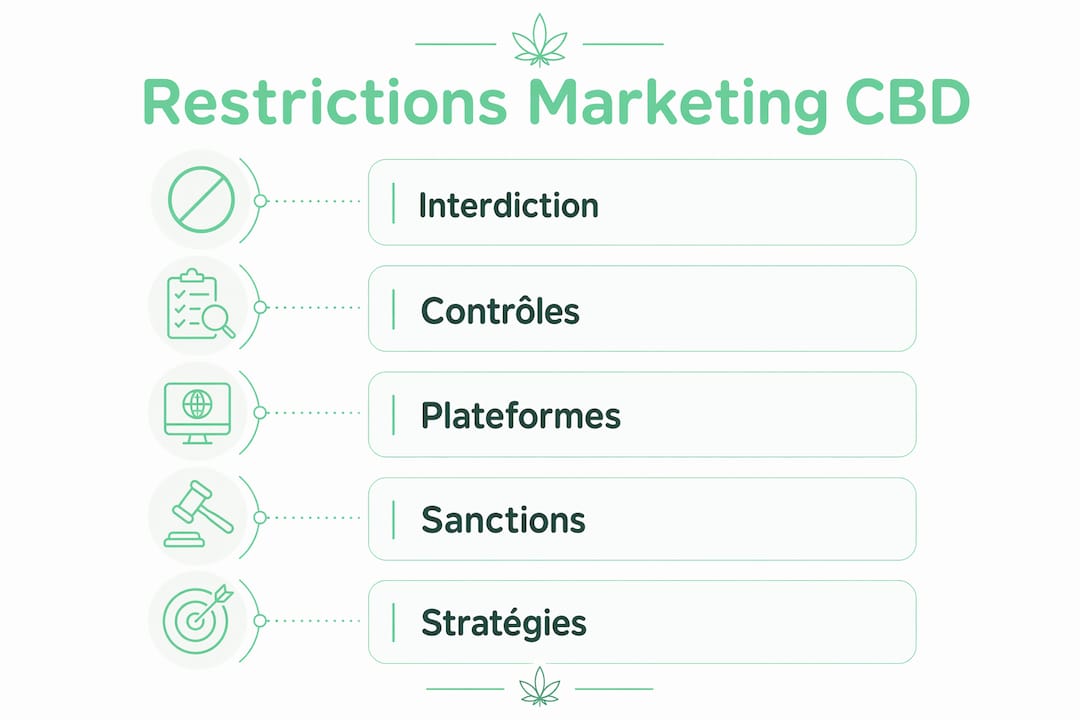
CBD marketing restrictions on digital platforms prohibit all paid advertising and therapeutic claims, without exception. This framework applies to Facebook, Instagram, TikTok, Google Ads, and YouTube, and is based on specific French and European legal regulations. The French Directorate General for Competition Policy, Consumer Affairs and Fraud Control (DGCCRF), the Directorate General for Food (DGAL), and European Regulation No. 1924/2006 govern these prohibitions. For professionals in the sector, understanding these CBD marketing platform restrictions is a prerequisite for any legal and sustainable communication.
What are the CBD marketing restrictions on digital platforms?
CBD marketing regulations rest on three pillars: the prohibition of therapeutic claims, the control of THC levels, and the monitoring of commercial communications by French and European authorities. These rules are not specific to digital platforms. They stem directly from French and European law, and the platforms apply them even more strictly than the law requires.
The DGCCRF (French Directorate General for Competition Policy, Consumer Affairs and Fraud Control) monitors the information on packaging and websites. All therapeutic claims are prohibited under European Regulation No. 1924/2006. Only claims relating to organoleptic properties and general well-being are permitted. This distinction is crucial: writing "promotes relaxation" is tolerated, while writing "treats anxiety" is punishable by law.
The VAT rate on CBD products is standardized at 20%, and each product must display a THC content of 0.3% or less, supported by a Certificate of Analysis (CoA). These traceability requirements also determine the legitimacy of any commercial communication. A product without a CoA cannot be legally promoted on any platform.
Since May 2026, the French Directorate General for Food (DGAL) has prohibited the sale and advertising of CBD food products without Novel Food authorization. This decision has affected approximately 2,000 shops in France, according to the French Union of CBD Producers (UPCBD). In practical terms, this means that CBD oils, herbal teas, and candies can no longer be promoted on any platform without this prior authorization.
Facebook and Instagram: what are the rules for CBD?
Facebook and Instagram prohibit all paid advertising for CBD products, without exception. This ban is automatically enforced by Meta's moderation systems, regardless of the advertiser's country. Even a 100% legal product with a THC content below 0.3% will be rejected at the campaign approval stage.

Organic content isn't spared either. Meta algorithms shadowban posts that directly mention CBD. Shadowbanning limits a post's reach to existing followers and excludes it from discovery feeds. In practice, a page that regularly posts about CBD sees its organic reach gradually shrink, without any explicit notification.
To communicate safely on these platforms, professionals in the sector use several approaches:
- Talking about organic hemp, terpenes, or aromas without explicitly mentioning CBD is pointless
- Publish educational content about plants, general well-being, or agricultural practices
- Avoid any term associated with recreational cannabis, which triggers algorithmic filters
- Highlighting certifications and traceability without making any health claims
- Use stories and live streams to create a connection with the existing community
Pro tip: Create a themed page about wellness and hemp rather than one focused on CBD. Meta search algorithms are less restrictive on these terms, and you'll build a wider audience.
How does TikTok regulate CBD-related content?
TikTok applies the strictest policy of all major social media platforms. Paid promotion of CBD is prohibited, and organic content is also heavily filtered. Unlike Meta, TikTok doesn't just limit reach: the platform deletes posts and can permanently ban an account for repeat offenses.
Exceptions are very limited. A few topical CBD products, such as creams or balms, may be listed under strict conditions in certain markets. In France, these exceptions are not systematically applied. Therefore, caution is advised when reviewing each listing.
The concrete consequences of not complying with these rules on TikTok are as follows:
- Post removed immediately without prior warning
- Reduced scope of the entire account (global shadowban)
- Temporary suspension or permanent banning of the account
- Loss of content history and established audience
TikTok remains useful for CBD brands, provided they never mention the product directly. Content about wellness rituals, relaxation, or natural practices generates engagement without triggering filters. This indirect approach requires more creativity, but it protects the account in the long run.
YouTube, LinkedIn and Google: what opportunities for CBD?
These three platforms offer very different levels of tolerance, and each deserves a distinct strategy.
-
YouTube tolerates educational content about CBD as long as it doesn't directly promote a product for sale. A video explaining how the endocannabinoid system works or the differences between hemp and cannabis can still be published. However, any video with a purchase link or a commercial call to action will be demonetized or removed. YouTube also prohibits advertising for CBD through Google Ads.
-
LinkedIn is the most accessible platform for professionals in the sector. A professional and informative tone is acceptable for B2B content about CBD. Sharing market analyses, regulatory updates, or studies on cannabidiol is perfectly acceptable. LinkedIn does not shadowban these topics and allows you to build professional contacts without high risk.
-
Google Ads almost always rejects ads related to CBD. This restriction applies to Search, Display, and Shopping campaigns. Attempts to circumvent it using generic terms are quickly detected and blocked.
Pro tip: Search engine optimization (SEO) remains the most reliable lever for CBD brands in 2026. A CBD e-commerce site data schema.org and accessible certificates of analysis, generates qualified traffic without depending on advertising platforms.
SEO, content marketing, and email marketing are the main levers for CBD brands in 2026. These channels escape the restrictions of social platforms and allow direct communication with customers.
What French and European legal framework governs CBD communication?
European and French law imposes specific constraints that explain why the platforms are so restrictive. Here are the fundamental rules to know:
| Ruler | Source | Impact on communication |
|---|---|---|
| Prohibition of therapeutic claims | EU Regulation No. 1924/2006 | No mention of treatment or cure allowed |
| THC level ≤ 0.3% required | DGAL / French regulations | Each product must have a verifiable CoA |
| Novel Food Authorization for CBD Foods | DGAL, since May 2026 | Advertising prohibited without prior authorization |
| Harmonised VAT at 20% | French tax authorities | No special treatment for CBD |
| Control of claims on packaging | DGCCRF | Targeted sanctions against non-compliant CBD sites |
The French Directorate General for Competition Policy, Consumer Affairs and Fraud Control (DGCCRF) applies targeted sanctions to CBD websites that use suspicious claims. These checks cover both e-commerce sites and social media. A poorly written Instagram post or product description can trigger proceedings.
Educational content must be filtered to remove any medical claims and references to recreational cannabis. It must also include traceable evidence, such as certificates of analysis, to prevent declassification by algorithms and authorities. This transparency requirement is both a legal obligation and a way to build trust with customers.
CBD legislation in France and the EU is constantly evolving. The changes to food products scheduled for May 2026 are a prime example. Staying abreast of these developments is essential for any professional in the sector.
Key points
CBD marketing restrictions on digital platforms prohibit all paid advertising and therapeutic claims, and only SEO, educational content and email marketing allow for sustainable and compliant growth in 2026.
| Point | Details |
|---|---|
| Paid advertising prohibited | Facebook, Instagram, TikTok and Google Ads reject all CBD ads without exception. |
| Organic Shadowban on Meta and TikTok | CBD posts are excluded from discovery feeds, limiting reach to existing subscribers. |
| Prohibited therapeutic claims | EU Regulation No. 1924/2006 prohibits any mention of treatment or cure on CBD products. |
| LinkedIn and SEO as alternatives | LinkedIn tolerates informative B2B content; organic SEO remains the most reliable channel. |
| Novel Food mandatory since May 2026 | CBD food products can no longer be promoted without prior authorization from the DGAL. |
What the restrictions taught me about CBD communication
The temptation, when starting out in the CBD sector, is to try to replicate classic marketing strategies: paid advertising, product posts on social media, Google campaigns. This approach systematically fails, and often at a high cost.
What I've observed over time is that successful brands don't try to circumvent restrictions. They build their authority in other ways. They invest in high-quality educational content, a regular newsletter, and strong SEO. Email marketing partially escapes the restrictions of social media platforms and creates a direct connection with customers. This is a significant advantage in such a constrained industry.
Distrust of mainstream social media is justified. An account built up over years can be banned in a matter of hours for a clumsy wording. Diversifying channels isn't an option; it's a structural necessity. LinkedIn for B2B, SEO for qualified traffic, email for customer loyalty. This three-pronged approach is more effective than any paid campaign.
Transparency is also an underestimated commercial lever. Displaying certificates of analysis, explaining production processes, and documenting traceability all build trust that advertising cannot buy. Novel Food and DGAL standards are binding, but brands that scrupulously adhere to them naturally stand out.
— Daniel
Lord Of CBD: Compliant products for demanding professionals
Selling CBD legally in France requires products that meet all regulatory requirements. Lord Of CBD selects rigorous producers, guarantees a THC level of less than 0.3% across its entire range, and provides accessible certificates of analysis for each product.
For professionals seeking to source compliant products and build a strong communication strategy, Lord Of CBD offers a selection of premium CBD in Marseille and throughout France. Resins, flowers, and oils are made from organic hemp, with complete traceability at every stage. This is the foundation of a credible and sustainable marketing strategy.
Frequently Asked Questions
Is it possible to advertise CBD for money in France?
No. Facebook, Instagram, TikTok and Google Ads prohibit all paid advertising for CBD products, regardless of their legal compliance.
Is organic content on social media allowed for CBD?
Organic posts are technically possible, but Meta and TikTok's algorithms apply a shadowban that limits their reach to existing followers and excludes them from discovery feeds.
What claims can be used to promote a CBD product?
Only statements relating to general well-being and organoleptic properties are permitted. Any therapeutic claim is prohibited by European Regulation No. 1924/2006 and monitored by the DGCCRF (French Directorate General for Competition Policy, Consumer Affairs and Fraud Control).
Which platform is the most accessible for B2B CBD marketing?
LinkedIn is the most tolerant platform for professional and informative CBD content. An educational and factual tone is accepted there without a high risk of restriction.
Which marketing channels will actually work for CBD in 2026?
Search engine optimization (SEO), content marketing, and email marketing are the most effective channels. They bypass the restrictions of social media platforms and allow for direct and lasting communication with customers.