



The legal labeling of CBD products in Europe is defined by a set of binding regulations that directly determine the legality of each product placed on the market. EU Regulation 1169/2011 on consumer information, the guidelines of the French Directorate General for Competition Policy, Consumer Affairs and Fraud Control (DGCCRF), and EU Regulation 2015/2283 on novel foods form the legal framework that every professional must understand. Since 2026, stricter regulations surrounding Novel Food status and the legal THC threshold of 0.3% in finished products have made labeling compliance more demanding than ever. Non-compliant labeling exposes the operator to immediate market withdrawal and even prosecution. Understanding these obligations is not optional; it is essential for commercial survival in this sector.
What information is mandatory on the label of a CBD product?
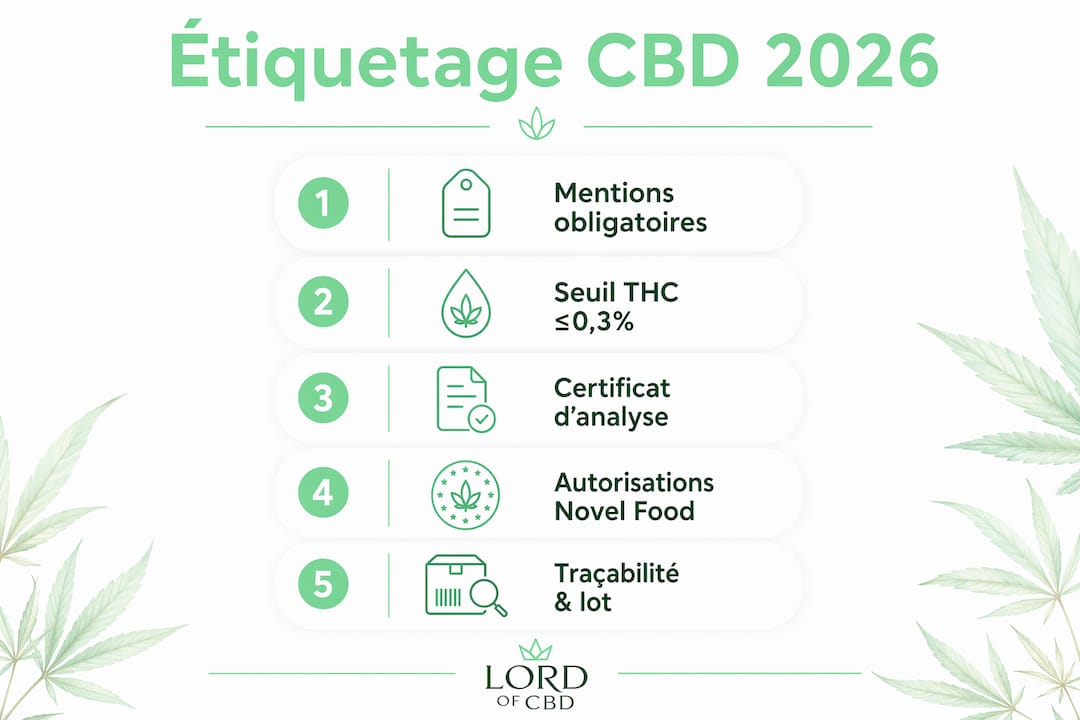
The mandatory information required by EU Regulation 1169/2011 covers eight distinct elements that every label must display without exception. The absence of even one of these elements is sufficient to render the product non-compliant in the eyes of the DGCCRF (French Directorate General for Competition Policy, Consumer Affairs and Fraud Control). Here is the information that must be included:
- Product name : the designation must be clear and not misleading. "CBD oil" or "Hemp flower" are acceptable formulations; "wellness supplement" alone is not.
- Net quantity : expressed in millilitres, grams or units depending on the nature of the product.
- CBD concentration : the exact level or quantity of cannabidiol present in the finished product must be explicitly stated.
- THC level : the mention of the threshold ≤ 0.3% on the finished product is required to attest to legal compliance.
- Batch number : essential for traceability in case of control or product recall.
- Storage conditions : temperature, light, humidity according to the specific characteristics of the product.
- Precautions for use : especially for pregnant women, children or people undergoing medical treatment.
- Identity of the person responsible for placing on the market : name, company name and address of the distributor or manufacturer established in Europe.
Pro tip: Have each label reviewed by a lawyer specializing in food or cosmetics law before printing. Upstream correction costs infinitely less than a product recall on the shelf.
The complete ingredient list must also be included on the label for food products, in descending order of ingredients. For sublingual oils, the list of excipients (hemp oil, MCT oil, etc.) is mandatory. French and European legislation on this point leaves no room for interpretation.
How does the European regulatory framework govern CBD labeling?
The regulatory framework rests on three distinct pillars that apply simultaneously depending on the product category. Professionals must identify the exact category of their product before designing the label, as the rules vary depending on whether it is a food, a cosmetic, or an e-liquid.
- EU Regulation 1169/2011 : sets out the general information requirements for foodstuffs marketed in Europe. This is the basis for any ingested CBD oil or gummy.
- EU Regulation 1924/2006 strictly prohibits any unauthorized health claims. Formulations such as "reduces stress," "promotes sleep," or "anti-inflammatory" are illegal on CBD packaging.
- EU Regulation 2015/2283 (Novel Food) : classifies CBD extracts as novel foods. Since May 15, 2026, the sale of CBD foods without Novel Food authorization is prohibited and results in immediate recall by the DGCCRF (French Directorate General for Competition Policy, Consumer Affairs and Fraud Control).
EU Regulation 1924/2006 prohibits any therapeutic claims on CBD products. The French Directorate General for Competition Policy, Consumer Affairs and Fraud Control (DGCCRF) is actively targeting products claiming health benefits and recommends the complete removal of therapeutic statements from packaging by 2026. Neutral labeling is no longer a marketing choice: it is a legal obligation.
CBD-based cosmetic products fall under EU Regulation 1223/2009, not food regulations. Labeling must therefore state the product's function, the INCI list of ingredients, and any specific precautions. E-liquids, on the other hand, are subject to the European Tobacco Products Directive (TPD) if nicotine is present, or to specific national regulations if it is not. Determining the regulatory category of your product is the first decision to make before designing any label.
The DGCCRF (French Directorate General for Competition Policy, Consumer Affairs and Fraud Control) conducts regular inspections in physical and online markets. CBD labeling is a key red flag for the authorities: simply mentioning CBD on a food or sublingual product without Novel Food authorization can trigger a swift recall. Sanctions range from warnings to market withdrawals, including significant administrative fines.
What are the traceability and certification requirements on the label?
Traceability is the invisible pillar of CBD compliance. It's not visible on the final label, but it determines the validity of everything on it. A batch number without a corresponding certificate of analysis is a major non-compliance during a DGCCRF audit.
The specific requirements to be met are as follows:
- Batch Certificate of Analysis (CoA) : A CoA is only valid if it is specific to the batch sold and produced by an independent laboratory accredited to ISO 17025.
- Lot/CoA consistency : the lot number on the label must exactly match the number on the certificate of analysis. Any discrepancy invalidates the document.
- Molecular purity of the catalogue : the operator is responsible for each batch and must guarantee the absence of prohibited molecules such as HHC, THCP or HHCPO.
- Archiving of Certificates of Aptitude (CoAs) : Certificates must be kept and readily accessible in case of an audit. A delayed response during an inspection is interpreted as a lack of documentation.
- Update with each new batch : a CoA from a previous batch does not cover the next batch, even if the product looks identical.
Pro tip: Create an internal tracking spreadsheet that links each product reference to its active batch number, Certificate of Authenticity (CoA), and expiration date. This document will be a lifesaver during any unexpected inspections.
| Element | Requirement | Consequences in case of absence |
|---|---|---|
| Batch number | Required on each unit | Immediate non-compliance |
| Certificate of analysis | Batch-specific, ISO 17025 laboratory | Invalid CoA, withdrawal possible |
| THC level verified | ≤ 0.3% of finished product | Seizure and prosecution |
| Identity of the person in charge | Name and address of the person placing the product on the market | Infringement of EU Regulation 1169/2011 |
A certificate without ISO 17025 accreditation or not specific to the batch is invalid. This invalidity can lead to immediate penalties and product recalls. Rigorous documentation is not a mere administrative formality; it provides direct legal protection for the operator.
What best practices should be adopted for compliant labeling in 2026?
Label compliance is not simply a matter of ticking a checklist. It requires consistent operational discipline, from product receipt to shelf placement. Regulatory changes in 2026 have rendered several previously tolerated practices illegal.
Best practices to implement immediately:
- Remove all health claims : formulations such as "anti-stress", "promotes relaxation" or "relieves pain" are prohibited by EU Regulation 1924/2006. Replace them with factual descriptions of the product.
- Check supplier labels : a product received with a non-compliant label is the responsibility of the distributor, not just the manufacturer. Check each delivery.
- Update labels with each batch change : a label printed in stock for several successive batches is a frequent source of non-compliance.
- Labeling should be tailored to the product category : cosmetics, food, and e-liquids do not have the same rules. A generic label rarely covers all categories.
- Anticipating Novel Food requirements : For any food product containing CBD, verify the existence of a valid Novel Food authorization before marketing. Novel Food and CBD regulations impose specific constraints on formulation and labeling.
Complete neutrality in packaging is now essential. Health claims deemed illegal in 2026 directly impact the commercial viability of CBD companies. Simple, factual, and accurate packaging is currently the only legally sound option.
Regulatory monitoring should be organized as an internal process, not as a reaction to inspections. Subscribe to official publications from the DGCCRF and EFSA. Regularly consult updates to the European Novel Food Register. Sustainable compliance relies on anticipation, not correction after the fact.
Key points
CBD labeling compliance in Europe requires rigorous end-to-end management, aligning every label entry with the batch, certificate of analysis, and regulatory category of the product.
| Point | Details |
|---|---|
| Mandatory THC threshold | Explicitly state ≤ 0.3% of finished product on each label. |
| Full legal notices | Include name, batch, CBD concentration, responsible party and storage conditions. |
| Zero health claims | Remove any therapeutic formulation under penalty of immediate withdrawal by the DGCCRF. |
| Batch traceability | Match each label to a valid CoA from an ISO 17025 accredited laboratory. |
| Novel Food Watch | Check for Novel Food authorization for any CBD food product before putting it on sale. |
What I observe on the ground after years in this sector
Most CBD retailers I meet underestimate a specific risk: they think compliance ends with the printed label. This is wrong. The DGCCRF (French Directorate General for Competition Policy, Consumer Affairs and Fraud Control) doesn't just check what's written on the bottle. It verifies the consistency between the label, the certificate of analysis, and the physical batch in stock. I've seen operators recall hundreds of units not because their label was incorrect, but because the corresponding Certificate of Analysis was dated from a previous batch.
The shift to neutral packaging is, in my opinion, the most difficult decision for entrepreneurs who have built their brands on wellness promises to accept. Yet, it's the only viable path. Simple packaging with accurate, factual information inspires more confidence in a discerning buyer than a list of unproven benefits. Clarity has become a selling point in itself.
My consistent recommendation is to treat compliance as a living process, not a one-off project. Appoint an internal regulatory watchdog. Schedule a labeling review for every new batch and every regulatory update. Companies that adopted this discipline before 2026 weathered the Novel Food tightening without sales disruptions. Others faced costly recalls.
Compliance is not a hindrance to growth. It is the foundation of long-term customer trust.
— Daniel
Lord Of Cbd supports professionals towards sustainable compliance
Lord Of CBD rigorously selects its producers to guarantee that each product complies with European legislation , with a THC content of less than 0.3% verified in the finished product and documented traceability for each batch. Professionals who source from Lord Of CBD benefit from organic hemp products, accompanied by the certificates of analysis necessary for their own labeling compliance. The team also advises on the legal information required for each product category, from flowers and oils to resins. To discover a selection of products compliant with the 2026 standards and benefit from expert support, consult the available range and contact the team directly.
Frequently Asked Questions
What THC level should be listed on the label of a CBD product?
The label must explicitly state a THC content of 0.3% or less, measured in the finished product. This threshold has been mandatory since 2026 for all legal sales in Europe.
Are health claims allowed on CBD packaging?
No. EU Regulation 1924/2006 prohibits any unauthorized therapeutic or health claims. Formulations such as "anti-stress" or "promotes sleep" expose the operator to immediate product withdrawal.
What is a valid certificate of analysis for a CBD product?
A valid certificate of analysis is specific to the batch sold and carried out by an independent laboratory accredited to ISO 17025. A generic CoA or one not specific to the current batch is considered invalid during a DGCCRF inspection.
Does Novel Food status affect the labeling of CBD food products?
Yes. Since May 15, 2026, all food products containing CBD must have a valid Novel Food authorization. Without this authorization, marketing is blocked and the product can be withdrawn immediately.
Who is responsible for label compliance in the event of an inspection?
The party responsible for placing the product on the market, whose name and address must appear on the label, is legally responsible for compliance. This includes the distributor, even if the product was manufactured by a third party.