



Herbal medicine for anxiety refers to the use of medicinal plants to modulate anxiety symptoms, and cannabidiol (CBD) now holds a recognized place within this field. CBD is a compound extracted from hemp (Cannabis sativa), which is legal in France as long as the THC level remains below 0.3%. Clinical evidence is accumulating, but its effectiveness varies depending on the type of anxiety. Herbal medicine for anxiety with CBD positions CBD as a valuable complement to traditional herbal remedies, provided that precise quality and dosage criteria are met. Lord Of CBD offers a range of products made from organic hemp to meet this growing demand.
How do CBD and plants affect anxiety?
CBD interacts with the endocannabinoid system, a network of CB1 and CB2 receptors found in the brain and nervous system. This network regulates mood, stress response, and emotional memory. CBD also modulates 5-HT1A serotonergic receptors, which are involved in regulating anxiety and are targeted by several conventional antidepressants.
Traditional anxiolytic plants work through different mechanisms. Valerian, passionflower, and lemon balm remain a recognized cornerstone of herbal medicine, even with the emergence of CBD as a new natural option. Valerian increases the availability of GABA, an inhibitory neurotransmitter that reduces neuronal excitability. Passionflower acts on benzodiazepine receptors without creating dependence. Lemon balm inhibits the enzyme that breaks down GABA, thus prolonging its calming effect.

Combining CBD with these plants can create synergies, but it should be approached with caution and under supervision to avoid interactions and optimize the therapeutic effect. Terpenes present in a full-spectrum hemp extract, such as linalool or myrcene, also enhance the anxiolytic action through what is known as the entourage effect.
Key mechanisms to remember:
- CB1/CB2 receptors : regulation of stress response and mood
- 5-HT1A receptors : serotonergic modulation, direct anxiolytic effect
- GABA : a common target of valerian, passionflower, and lemon balm
- Entourage effect : synergy between cannabinoids and terpenes in full-spectrum extracts
Pro tip: Combining a full-spectrum CBD oil with lemon balm tea in the evening amplifies the relaxing effect without major risk for most healthy adults. Consult a doctor before combining these if you are currently taking any medication.
What is the proven effectiveness of CBD according to the types of anxiety?
Clinical evidence varies depending on the specific anxiety disorder being addressed. The strongest studies focus on social anxiety and generalized anxiety, with encouraging results at high doses. When choosing a CBD product suitable for generalized anxiety, the quality of the extract and the regularity of intake are just as important as the dosage.
| Type of anxiety | Level of evidence | Remarks |
|---|---|---|
| Social anxiety | Moderate to good | Controlled studies with doses of 300 mg |
| Generalized anxiety | Moderate | Positive results, short-term studies |
| Chronic stress | Observational | Improvement reported, few controlled trials |
| Anxiety related to autism spectrum disorder (ASD) | Observational | Significant reduction in a 2019 study |
| Sleep disorders related to anxiety | Moderate | Documented improvement in sleep quality |
An observational study conducted in 2019 with 60 children with autism spectrum disorder showed a 71% reduction in anxiety with a CBD-rich oil. These results illustrate the potential of CBD for behavioral disorders associated with anxiety, even if their scope remains limited to an observational setting.
"The doses used in clinical trials for anxiety are generally between 200 and 600 mg per day. Commercial products contain on average 10 to 50 mg per dose. This difference explains why some people do not experience a noticeable effect with common dosages."
This difference between studied and commercially available doses is one of the most frequent blind spots in the communication surrounding CBD. It doesn't mean that low doses are useless, but rather that expectations should be adjusted accordingly. Examples of behavioral disorders alleviated by CBD are still mostly derived from observational studies, which limits the generalizability of the findings.
How to choose a quality CBD for anxiety?
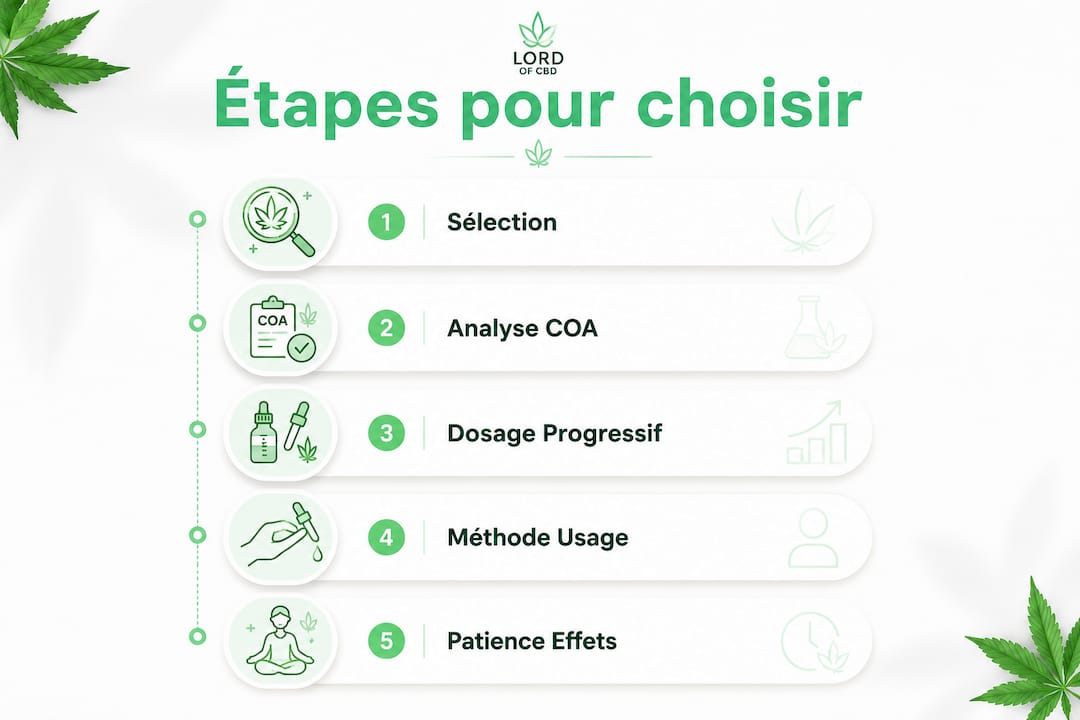
The quality of a CBD product directly determines its effectiveness and safety. Three criteria are non-negotiable: the origin of the hemp, the extraction method, and the availability of certificates of analysis.
Essential criteria for making the right choice:
- Organic hemp : free from pesticides and heavy metals, guaranteeing a preserved phytochemical profile
- Supercritical CO2 extraction : the reference method that preserves cannabinoids and terpenes without residual solvents.
- Product spectrum : Isolate contains only pure CBD; broad spectrum includes other cannabinoids without THC; full spectrum retains all compounds, including traces of THC less than 0.3%.
- Certificates of analysis : an independent laboratory must confirm the CBD content, the absence of contaminants, and the compliant THC level.
- Appropriate concentration : for anxiety, a 10% oil is a good starting point; 20% or 30% concentrations are suitable for more significant needs.
Full-spectrum oils offer an entourage effect that amplifies the anxiolytic benefits thanks to the synergy between cannabinoids and terpenes. This effect is absent in pure isolates. Lord Of CBD selects producers whose extracts are systematically laboratory tested, guaranteeing the traceability of each batch.
Pro tip: Always check that the Certificate of Analysis (COA) is less than 12 months old and issued by an ISO 17025 accredited laboratory. A seller who refuses to provide it upon request is not reliable.
What dosage and method of administration should I choose?
CBD dosage for anxiety follows a gradual titration approach. This method involves starting with a low dose and then increasing it in increments until the minimum effective dose is found.
- Start with 10–15 mg per day for one week. This recommended starting dose allows for an assessment of tolerance without risk of overdose.
- Increase by 5 mg every 5–7 days if the effect is insufficient. The slow increase limits side effects such as drowsiness or mild nausea.
- Keep a log : note the dose, time of administration, intensity of anxiety, and effects experienced. This tracking helps to accurately identify the effective dose.
- Do not exceed 50 mg per day when self-medicating. The National Academy of Medicine sets this limit to avoid adverse effects without medical supervision.
- Consult a doctor before increasing beyond this limit or if you are taking any associated medication.
The route of administration significantly affects efficacy. Sublingual oil offers a bioavailability of 20–35%, compared to 5–15% for capsules or gummies. This means that a 20 mg dose of sublingual oil delivers as much active CBD as a 40–60 mg dose in a capsule. To maximize absorption, hold the drops under your tongue for 60 to 90 seconds before swallowing.
Pro tip: The most common mistake is starting with too low a dose and jumping to conclusions about CBD's effectiveness. Give yourself at least three weeks at a stable dose before assessing the results.
What are the advantages and limitations of CBD in herbal medicine against stress?
CBD offers real benefits, but also limitations that every informed user should be aware of. A clear-headed approach avoids disappointment and unnecessary risks.
Documented advantages:
- Measurable reduction in anxiety across several types of disorders, including social anxiety and autism-related anxiety
- Good general tolerance at usual doses, with no known physical dependence
- Complementarity with classic anxiolytic plants for an integrated phytotherapeutic approach
- Legally available in France in the form of oils, capsules and flowers with a THC content of less than 0.3%
Limitations and precautions:
- Theplacebo effect accounts for a significant portion of the benefits experienced outside of clinical settings. This does not diminish the value of CBD, but it does serve as a reminder that ritual and belief contribute to the perceived effect.
- CBD inhibits certain liver enzymes of the CYP450 system, which can alter the metabolism of antidepressants, anxiolytics, or anticoagulants. Medical advice is essential if you are currently taking any medication.
- Long-term clinical studies are still lacking. Current conclusions are often based on short or observational studies.
- Product quality varies greatly on the market. A poorly extracted or poorly preserved product loses some of its active ingredients.
For the use of CBD in herbal medicine , integration into a comprehensive strategy remains the best approach. CBD does not replace cognitive behavioral therapy or prescribed medical treatment. It complements it.
Key points
CBD has a legitimate place in herbal medicine for anxiety, provided that a certified product is chosen, a gradual titration is applied and the limit of 50 mg per day is respected in self-medication.
| Point | Details |
|---|---|
| Mechanism of action | CBD acts on CB1/CB2 and 5-HT1A receptors to modulate anxiety. |
| Effectiveness according to the disorder | The evidence is strong for social anxiety and observational for ASD. |
| Product selection | Opt for a full spectrum product made from organic hemp with an ISO 17025 certificate of analysis. |
| Safe dosage | Start at 10–15 mg/day and do not exceed 50 mg/day without medical supervision. |
| Drug interactions | CBD inhibits CYP450; consult a doctor if you are taking other medication. |
What I've learned after years of following the CBD market
The biggest misconception surrounding CBD and anxiety is the idea that you can simply buy an oil and wait. The market is flooded with under-dosed, poorly extracted products, or products made from hemp of dubious quality. I've seen people conclude that CBD was ineffective after two weeks of taking 5 mg per day with a 3% oil bought at the supermarket. It wasn't the CBD that failed.
What really works is the combination of a certified product, gradual dosing, and realistic expectations. CBD doesn't eliminate anxiety overnight. It gradually reduces stress reactivity, often improving sleep first, and then overall mood. This process takes several weeks.
I also remain cautious about overly enthusiastic claims. Serious clinical studies use doses far higher than those offered by most commercial products. This reality doesn't disqualify CBD, but it does demand honesty. For cases of severe anxiety or diagnosed anxiety disorders, CBD alone is insufficient. It must be used in conjunction with medical or psychotherapeutic treatment.
My most practical advice: start with a beginner-friendly dosage guide, choose a product whose certificate of analysis you can read, and give yourself at least a month before making an assessment. Patience is the most underrated skill when using CBD.
— Daniel
Lord Of CBD, for herbal anxiety relief with a solid foundation
Lord Of CBD selects each product according to strict criteria: organic hemp, supercritical CO2 extraction, and certificates of analysis available for each batch. The full-spectrum oils in the range are formulated to offer the entourage effect documented in studies on anxiety.
The available concentrations cater to both beginners and experienced users, ranging from 5% to 30%. Lord Of CBD's customer service team assists each customer in choosing the concentration and format best suited to their needs. Delivery is secure and fast throughout France. For access to their premium CBD range or to find a pickup point in Marseille, Lord Of CBD remains a reliable choice in the French market.
Frequently Asked Questions
Is CBD legal in France for treating anxiety?
CBD is legal in France in the form of products containing less than 0.3% THC. Its use is considered for wellness purposes and not for any official therapeutic indication.
Which plants can be combined with CBD to combat anxiety?
Valerian, passionflower, and lemon balm are the best-documented herbs for anxiety. Combining them with CBD is possible, but should be supervised to avoid interactions.
How long does it take to feel the effects of CBD on anxiety?
The first effects on sleep often appear within 1 to 2 weeks. The effects on chronic anxiety generally require 3 to 6 weeks at a stable dose.
Which form of CBD should I choose for generalized anxiety?
Full-spectrum sublingual oil is the most effective form, with a bioavailability of 20–35% compared to 5–15% for capsules. It also allows for precise dose adjustment.
Can CBD replace a prescribed anxiolytic?
No. CBD is not a substitute for prescribed medical treatment. Any modification to an anxiolytic treatment must be done with a doctor's approval, particularly due to interactions with CYP450.