



Cannabidiol (CBD) is a non-psychoactive compound found in hemp that acts on anxiety through biological pathways distinct from those of conventional medications. Benzodiazepines and selective serotonin reuptake inhibitors (SSRIs) remain the treatments approved by health authorities for anxiety disorders, while CBD retains its status as a wellness supplement without therapeutic authorization in France. Understanding the differences between CBD and anxiety medications allows for informed choices, avoids substitution errors, and better manages symptoms on a daily basis.
What are the mechanisms of action of CBD compared to those of conventional anxiety medications?
CBD and conventional anxiolytics act on different neurobiological systems. This fundamental difference explains why their effects, onset of action, and risks are not the same.
CBD acts primarily on two targets:
- 5-HT1A receptors : These are serotonin receptors. CBD stimulates them directly, producing a gradual calming effect. This is the same mechanism as some antidepressants, but without blocking serotonin reuptake.
- The endocannabinoid system : CBD modulates CB1 and CB2 receptors present in the brain and nervous system. This system naturally regulates stress, fear, and emotional responses.
Benzodiazepines amplify the action of GABA, the brain's main inhibitory neurotransmitter. The result is rapid and powerful sedation. SSRIs, on the other hand, increase the availability of serotonin in the synapses, with an effect that lasts for several weeks.
Pro tip: If you are already taking an SSRI, be aware that CBD can interact with the liver enzymes that metabolize this medication. Talk to your doctor before combining them.

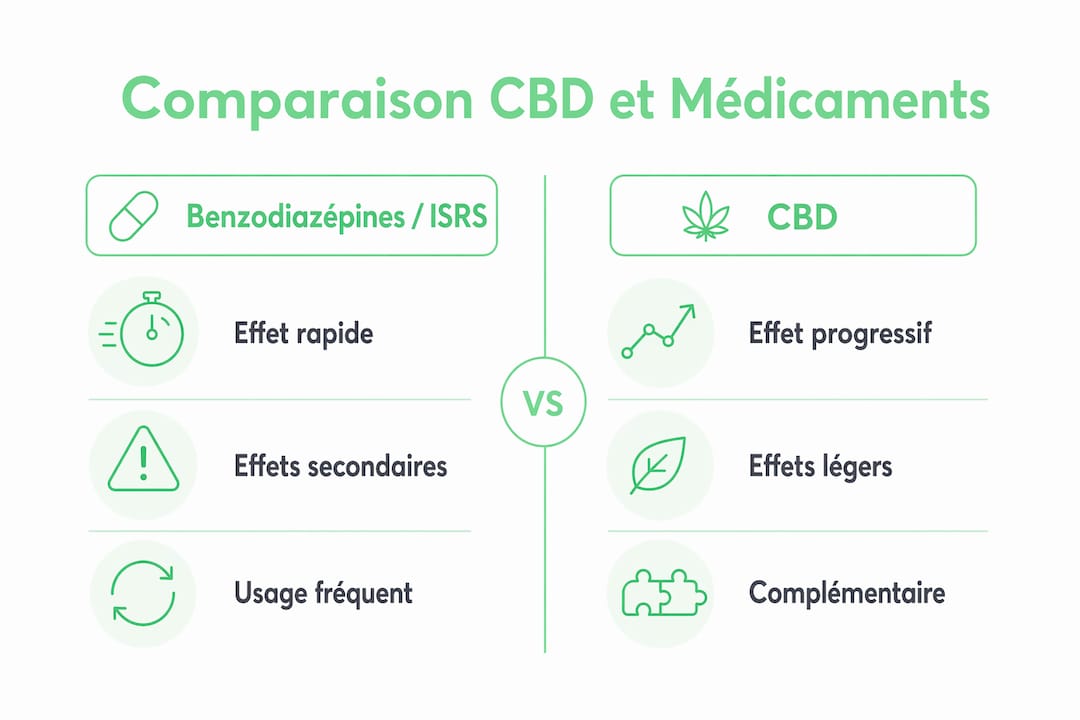
The practical consequence of these different mechanisms of action is clear: benzodiazepines act within 15–45 minutes, making them useful in acute crises. CBD, on the other hand, produces its effects within 30 minutes to 2 hours depending on the route of administration, with a milder and more gradual profile.
What are the timeframes for effectiveness and side effects of CBD versus anxiety medications?
The speed of action and the profile of side effects are the two most decisive criteria for choosing between CBD and drug treatment.
| Criteria | Benzodiazepines / SSRIs | CBD |
|---|---|---|
| Action deadline | 15–45 min (benzodiazepine) / 2–6 weeks (SSRI) | 30 minutes to 2 hours |
| Risk of addiction | Raised for benzodiazepines | Not present according to the WHO (2018) |
| Common side effects | Drowsiness, cognitive impairment, withdrawal | Mild fatigue, dry mouth, occasional nausea |
| Recommended usage time | A maximum of 12 weeks for benzodiazepines | Not limited by regulations |
| Reimbursement in France | Yes (with a prescription) | No |
Approximately 60 to 70% of people find relief with conventional anxiolytic treatments, but 30% discontinue them due to side effects. This figure illustrates an often underestimated clinical reality: tolerance to benzodiazepines develops rapidly, leading to increased doses to achieve the same effect.
CBD has a significantly milder side effect profile. The WHO confirmed in 2018 that CBD has no potential for abuse. This does not mean it is risk-free, but rather that the risk of physical dependence is absent.
An often overlooked point: CBD has a biphasic effect. At moderate doses, it reduces anxiety. At very high doses, it can, on the contrary, worsen it. This phenomenon does not occur with benzodiazepines, whose sedative effect increases linearly with the dose.
Can CBD replace or complement anxiety medications?
CBD is not a substitute for anxiety medication. This statement is not a general warning; it is based on concrete clinical and regulatory data.
Clinical studies show that CBD is more effective for situational anxiety (public speaking, occasional stress) than for severe chronic anxiety disorders. For a diagnosed generalized anxiety disorder or panic disorder, medical supervision with approved treatment remains essential.
Here's how to approach a transition or complementarity in a safe way:
- Consult a doctor before making any changes. Stopping anxiolytic medication on your own is dangerous. Abruptly stopping benzodiazepines can cause seizures, severe insomnia, and a resurgence of anxiety.
- Follow a gradual dose reduction protocol. The standard clinical recommendation is a 10% dose reduction every two weeks, under medical supervision.
- Introduce CBD alongside, not as a replacement for, prescribed treatment. CBD can support a transition period, but should not be used as a standalone substitute for prescribed medication.
- Monitor for drug interactions. CBD inhibits the liver enzymes CYP3A4 and CYP2C19, which can alter blood concentrations of anxiolytic medications. This interaction via CYP450 is documented and requires biological monitoring.
Pro tip: Always inform your doctor if you are using CBD. This information is medically relevant, not trivial.
CBD does not have marketing authorization (MA) as a medicine in France. It is not reimbursed and cannot be prescribed for anxiety. This regulatory reality does not diminish its potential, but it does require a medical consultation for any substitution treatment.
What are the practical recommendations for using CBD safely?
Choosing a quality CBD product is the first step to achieving a real effect. The market is not very standardized, and there are significant differences in quality.
- Demand a Certificate of Analysis (COA). A study published in JAMA in 2017 revealed that 26% of CBD products were underdosed, 43% overdosed, and 18% contained undeclared THC. A COA issued by an independent laboratory is the only reliable guarantee.
- Choose between full-spectrum and broad-spectrum CBD. Full-spectrum products contain other cannabinoids and terpenes that amplify the effects of CBD (the entourage effect). Pure CBD isolate is more predictable but potentially less effective for anxiety.
- Adhere to the effective doses observed in studies. Clinical studies use doses of 300–600 mg per day, well above the common commercial doses of 10–50 mg. A dose of 25–50 mg per administration remains the most frequently cited range for a noticeable anxiolytic effect without the risk of a biphasic effect.
- Monitor your individual response. CBD's effectiveness varies depending on metabolism, method of administration, and the nature of the anxiety. Keeping a diary of doses and effects helps with quick adjustments.
Pro tip: Always start with the lowest dose and gradually increase it over two weeks. Consult this beginner dosage guide to structure your approach.
Some of the perceived effects of CBD on mild anxiety may be due to a placebo effect, particularly for everyday stress. This isn't a reason to dismiss it, but it is a reason to remain clear-headed about what CBD can and cannot do.
Key points
CBD and anxiolytic medications act through distinct mechanisms, which necessitates a complementary approach rather than direct substitution.
| Point | Details |
|---|---|
| Different mechanisms | CBD acts on 5-HT1A receptors and the endocannabinoid system, benzodiazepines on GABA. |
| Contrasting response times | Benzodiazepines take effect in 15–45 minutes, CBD in 30 minutes to 2 hours. |
| Side effect profile | CBD does not create physical dependence, unlike benzodiazepines which are limited to 12 weeks. |
| No autonomous substitute | Abruptly stopping an anxiolytic is dangerous; any transition must be medically supervised. |
| Product quality is crucial | Require a COA to avoid products with incorrect dosages or containing undeclared THC. |
What I've learned from following people using CBD and medication
After years of observing how people manage their anxiety, one thing strikes me: most aren't looking to choose between CBD and medication. They're looking to suffer less, with as few side effects as possible.
What I often see is a timing error. People stop their benzodiazepines cold turkey because they've started CBD and feel better. That's risky. The initial improvement might come from the CBD, but also from simply taking back control of their healthcare journey. The placebo effect is real and documented, and there's no shame in acknowledging it.
What really works is combining rigorous medical supervision with a gradual approach. CBD can be a useful tool in this process, especially for its benefits on mild to moderate chronic anxiety . But it doesn't replace a diagnosis, and even less so treatment tailored to a severe disorder.
My conviction: CBD deserves to be taken seriously, not as a magic alternative, but as a potentially useful supplement when it is well chosen, well dosed and integrated into a consistent monitoring program.
— Daniel
Lord Of CBD, for controlled CBD tailored to your well-being
Choosing a high-quality CBD product is essential for experiencing real relief from anxiety. Lord Of CBD rigorously selects its producers and offers products made from organic hemp, with a THC content of less than 0.3% and available laboratory analyses. Whether you want to start with a gentle formula or explore higher concentrations, the Lord Of CBD range covers all needs. Lord Of CBD products come with personalized advice to help you find the right approach, without guesswork.
Frequently Asked Questions
Is CBD legal in France for anxiety?
CBD is legal in France as a wellness supplement, provided the THC content is less than 0.3%. It is not authorized for marketing as a medication for anxiety.
Is CBD addictive?
No. The WHO confirmed in 2018 that CBD does not present a potential for abuse or physical dependence, unlike benzodiazepines whose use is limited to 12 weeks.
What dose of CBD is effective against anxiety?
Clinical studies use doses of 300–600 mg per day, but a dose of 25–50 mg per intake is the range most often cited for a noticeable effect without risk of anxiogenic effect at high doses.
Can CBD and antidepressants be combined?
Combining these medications is possible but requires medical advice. CBD inhibits the CYP3A4 and CYP2C19 enzymes, which can alter the blood concentration of SSRIs and other anxiolytic drugs.
Does CBD replace benzodiazepines?
No. CBD can be used alongside a supervised tapering process, but it does not replace prescribed medication. Stopping a benzodiazepine on your own is medically dangerous.