




CBD is a natural compound derived from hemp, with no psychoactive effects, while a veterinary medicine is a product authorized by the state to treat a specific animal condition. Understanding the differences between CBD and veterinary medicines protects your pet from costly care errors. CBD acts on the endocannabinoid system to modulate inflammation, pain, and anxiety, without targeting a specific disease. A veterinary medicine, on the other hand, has a Marketing Authorization (MA), has undergone controlled clinical trials, and requires a regulated prescription. These two approaches are not necessarily opposed, but they are not substitutes for each other. Knowing which one to choose, and when, makes all the difference for your companion's well-being.
What are the scientific and regulatory bases that distinguish CBD from veterinary medicines?
The legal framework clearly separates these two categories of products. In France, no veterinary medicine containing CBD is authorized in 2026 according to the ANMV (National Agency for Veterinary Medicines). This means that a veterinarian cannot legally prescribe CBD as a medical treatment for your pet.
Veterinary medicines, on the other hand, go through a rigorous process before reaching the market:
- Preclinical and controlled clinical studies on the target species
- Safety, efficacy and quality assessment by the ANMV
- Granting of a marketing authorization before any commercialization
- Complete traceability from manufacturing to dispensing
- Post-marketing pharmacovigilance monitoring
CBD products for animals, on the other hand, are marketed as food supplements. They do not have marketing authorization (MA) and their quality varies considerably from one manufacturer to another. Veterinary medicines with MA guarantee quality, purity, and efficacy, which unauthorized CBD supplements cannot provide.
The French National Order of Veterinarians reminds the public that prescribing CBD as a medical treatment remains outside the legal framework in France. A veterinarian who recommends CBD does so for informational purposes, not as an official therapeutic act.
Clinical research on CBD for animals remains preliminary. Available studies involve small sample sizes, and their findings do not yet support the use of CBD as a recognized medical treatment.
How do CBD and veterinary drugs work in the animal body?
CBD acts indirectly on the endocannabinoid system, a network of receptors present in the brain, organs, and immune system of most mammals. It does not bind directly to CB1 and CB2 receptors, but modulates their activity, which influences pain perception, inflammation, and emotional state. This diffuse action explains why CBD can act on several symptoms simultaneously, without targeting a specific condition.

Veterinary medicines work differently. Each active ingredient targets a specific biological mechanism: a non-steroidal anti-inflammatory drug (NSAID) blocks the COX enzymes responsible for inflammation, an antiepileptic stabilizes the electrical activity of neurons, and an antibiotic destroys or inhibits pathogenic bacteria. This precision of action is both their strength and their limitation: they are very effective on their intended target, but have no effect on other systems.
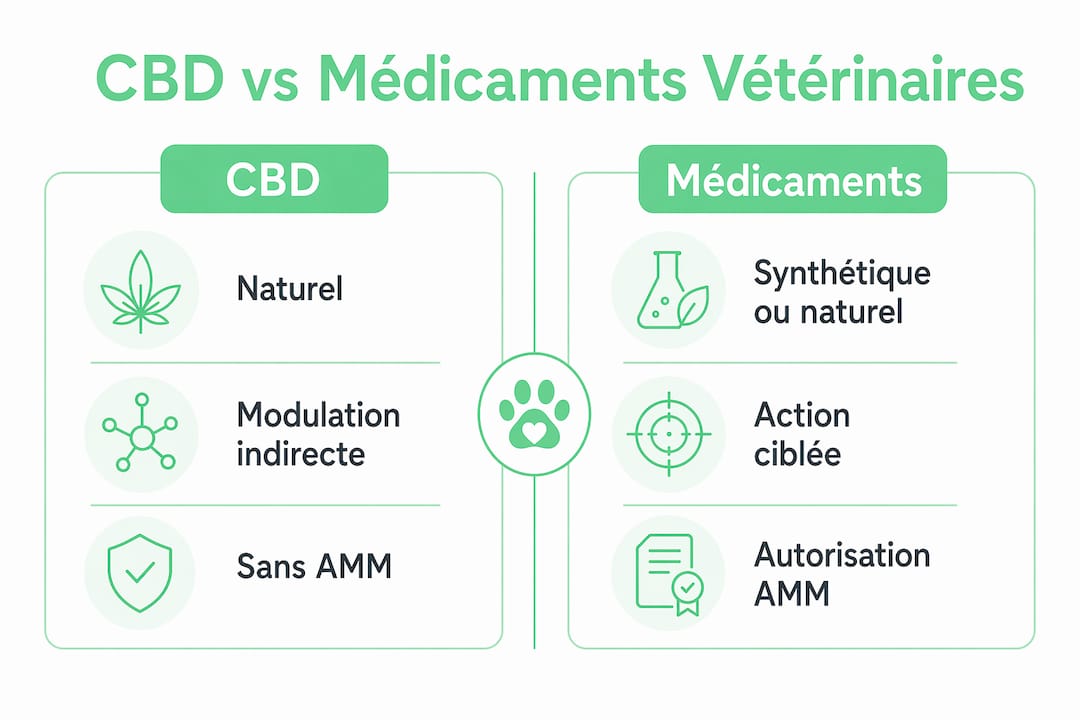
| Criteria | CBD | Veterinary medicine |
|---|---|---|
| Mode of action | Indirect modulation of the endocannabinoid system | Targeting a specific biological mechanism |
| Proof of effectiveness | Preliminary studies, small samples | Controlled clinical trials, mandatory marketing authorization |
| Side effects | Drowsiness, digestive problems (rare) | Variables depending on the molecule, documented |
| Prescription | Not required | Mandatory for most |
| Interactions | Inhibition of cytochrome P450 | Documented by molecule |
A point often overlooked by pet owners: CBD inhibits the cytochrome P450 enzyme, which can alter the metabolism of several common veterinary medications. Specifically, if your dog is taking an anti-seizure medication and you add CBD, the blood concentration of the medication may rise or fall unpredictably. Consult the drug interaction risk panel before any combined use.
Species differences are also crucial. In dogs, the high density of CB1 receptors in the cerebellum explains their increased sensitivity to cannabinoids. Cats metabolize cannabinoids even more slowly, increasing the risk of accumulation. Horses, on the other hand, have a unique digestive system that alters the absorption of orally administered products. Specific precautions for equines are detailed in the CBD for Horses.
Pro tip: Never give your pet a CBD product formulated for humans. Additives like xylitol or certain essential oils, common in human products, are toxic to dogs and cats.
What are the practical uses, indications and limitations of CBD compared to veterinary medicines?
The available studies on CBD for animals focus on three main areas. A study of 16 dogs with osteoarthritis (2018) and another of 26 dogs with epilepsy (2019) showed improved mobility and a reduction in seizures. These results are encouraging, but the sample sizes remain too small to conclude that there is established clinical efficacy. CBD for anxious dogs and cats has also shown positive results, particularly for anxiety disorders in dogs.
Veterinary medicines, on the other hand, cover specific and legally regulated indications:
- Bacterial, viral or parasitic infections (antibiotics, antiparasitics)
- Severe epilepsy (phenobarbital, potassium bromide)
- Post-operative pain (NSAIDs, veterinary opioids)
- Chronic diseases such as diabetes or kidney failure
- Heart, hormonal, or autoimmune disorders
The veterinary cascade of treatment is a legal requirement in France. It mandates that an authorized veterinary medicine be prescribed first before considering any other option for a treatable condition. Replacing a prescribed treatment with CBD without veterinary advice exposes your pet to a real risk of undertreatment.
The dosage of CBD for animals also requires special attention. A typical dosage is between 1 and 8 mg of CBD per day, depending on the dog's weight. This amount varies depending on the health condition, breed, and product formulation. The comprehensive guide on CBD dosage for dogs and cats details the recommended administration protocols.
Pro tip: Always start with the lowest dose and gradually increase it over two to three weeks. Note any changes in behavior, appetite, and mobility to inform your veterinarian.
Side effects of CBD are rare but real: drowsiness, digestive problems, and a drop in blood pressure. Regular veterinary monitoring is essential, especially during the first few weeks of use.
How to choose between CBD and veterinary medicines: quality and safety criteria
The decision depends primarily on the nature of your pet's health problem. For any diagnosed condition, the prescribed veterinary medication remains the gold standard. CBD can play a complementary role in improving daily comfort, reducing anxiety, or supporting mobility, but never as a replacement for established medical treatment.
To evaluate a CBD product intended for your pet, check these points:
- Independent certificate of analysis : a third-party laboratory must confirm the CBD content and the absence of THC above 0.3%
- Absence of toxic additives : CBD products for animals must be free of xylitol and unsuitable essential oils.
- Animal-specific formulation : never a product designed for humans
- Traceability of source : organic hemp, identifiable producer
- THC content below 0.3% : above this level, the product becomes toxic to animals.
For veterinary medicines, the criteria are different and non-negotiable:
- Marketing authorization issued by the ANMV or the EMA (European Medicines Agency)
- Prescription issued by a veterinarian after clinical examination
- Dispensing at a veterinary pharmacy or approved clinic
- Complete instructions for use, including dosage and contraindications
Authorized natural veterinary medicines are rare and subject to strict off-label prescription. This scarcity contrasts sharply with the proliferation of unregulated CBD supplements on the market. Therefore, owner vigilance is all the more crucial.
Pro tip: Bring the label and certificate of analysis for the CBD product to your veterinarian before administering it. A professional can spot a problematic ingredient you might have missed in seconds.
Veterinarians recommend an individualized approach to dosage and careful monitoring to prevent interactions and adverse effects. This recommendation applies to CBD as well as any other medication introduced into your pet's treatment.
Key points
CBD and veterinary medicines respond to different logics: one modulates comfort without marketing authorization, the other treats specific pathologies with clinically proven efficacy.
| Point | Details |
|---|---|
| Legal status of CBD | No CBD-based veterinary medicines are authorized in France in 2026 according to the ANMV. |
| Therapeutic cascade | The law requires that an authorized medication be prescribed before any other option for a diagnosed condition. |
| Drug interactions | CBD inhibits cytochrome P450 and may alter the effectiveness of ongoing veterinary treatments. |
| CBD quality criteria | Demand a certificate of analysis, an animal-specific formulation, and a THC level of less than 0.3%. |
| Complementary role | CBD can improve daily comfort, but it should never replace prescribed veterinary treatment. |
My opinion after years of following the evolution of CBD for animals
The question I get asked most often by pet owners is this: "Can CBD replace my dog's medication?" My answer is always no, and here's why this confusion persists.
The CBD market for pets has exploded far faster than the science has kept pace. Hundreds of products appeared on store shelves even before the first serious studies were published. As a result, well-intentioned pet owners sometimes delayed necessary medical treatment, believing that CBD alone would suffice.
What I've also observed is that CBD has real value when used correctly. An older dog undergoing anti-inflammatory treatment for arthritis can see its quality of life improved by adding a quality CBD product, under veterinary supervision. It's not an alternative, it's a complement. The distinction is crucial.
French regulations are evolving. Clinical studies are accumulating slowly but surely. In a few years, we will likely have veterinary protocols officially incorporating CBD. But in 2026, caution is still advised. Talk to your veterinarian, show them the products you are considering, and never make a therapeutic decision on your own.
— Daniel
CBD products for animals, with the transparency you deserve
Your pet deserves products whose exact composition you know. Lord Of Cbd selects CBD products made from organic hemp, with a THC content of less than 0.3%, and certificates of analysis are available for each product.
Every product in Lord Of CBD's premium range is traceable from cultivation to delivery. Before administering anything to your pet, consult your veterinarian and rely on reliable information. Lord Of CBD provides clear guidance to help you make the right, informed choice.
Frequently Asked Questions
Can CBD replace a prescribed veterinary medicine?
No. CBD does not replace veterinary medications but can be used as a complement to improve quality of life, under veterinary supervision. Discontinuing prescribed treatment without medical advice exposes your pet to a real risk.
Is CBD for animals legal in France in 2026?
CBD is legal as a food supplement, but no veterinary medicine based on CBD is authorized by the ANMV in France in 2026. A veterinarian therefore cannot prescribe it as an official treatment.
What are the risks of interactions between CBD and veterinary medicines?
CBD inhibits the cytochrome P450 enzyme, which can alter the blood concentration of certain veterinary drugs. This risk is particularly significant for antiepileptics and immunosuppressants.
What dosage of CBD should I give my dog or cat?
The typical dosage is between 1 and 8 mg of CBD per day, depending on the dog's weight. For cats, caution is even more important because they metabolize cannabinoids more slowly. Always consult a veterinarian before starting.
How can I recognize a quality CBD product for my pet?
A reliable product will have a certificate of analysis from an independent laboratory, a THC content of less than 0.3%, and a formulation free of toxic additives such as xylitol. Avoid any product designed for human consumption.