




Cannabidiol (CBD) is defined as a non-psychoactive compound found in hemp that acts on the mammalian endocannabinoid system to regulate pain, stress, and inflammation. This biological system is present in dogs and cats, making CBD relevant to animal health. The analgesic, anxiolytic, and anti-inflammatory properties of CBD are the subject of increasing veterinary studies, particularly in France, where ANSES (the French Agency for Food, Environmental and Occupational Health & Safety) and the French National Order of Veterinarians regulate its use. The benefits of CBD for pets are real, but they require a rigorous approach: THC-free products, appropriate dosage, and veterinary supervision.
1. What are the effects of CBD on pain and inflammation?
CBD reduces joint pain and inflammation in dogs and cats by acting on cannabinoid receptors in the central and peripheral nervous systems. A study on canine osteoarthritis published in Frontiers in Veterinary Science by Gamble et al. in 2018 showed a significant improvement in mobility in 16 dogs treated twice daily with CBD oil. This result is tangible: dogs that struggled to climb stairs regained normal locomotion after a few weeks of treatment.
The analgesic effects of CBD are primarily observed in cases of osteoarthritis, post-operative pain, and chronic inflammatory diseases. French veterinarians report noticeable improvements in posture, willingness to move, and sleep quality in treated animals.
- Reduction of joint pain associated with osteoarthritis
- Reduction of swelling and inflammatory redness
- Improvement in general mobility and appetite
- Improved sleep quality in animals in pain
Pro tip: Wait 2 to 4 weeks before assessing the effect of CBD on pain. Changing the dose too soon skews the assessment and increases the risk of side effects.
2. How does CBD help manage stress and anxiety?
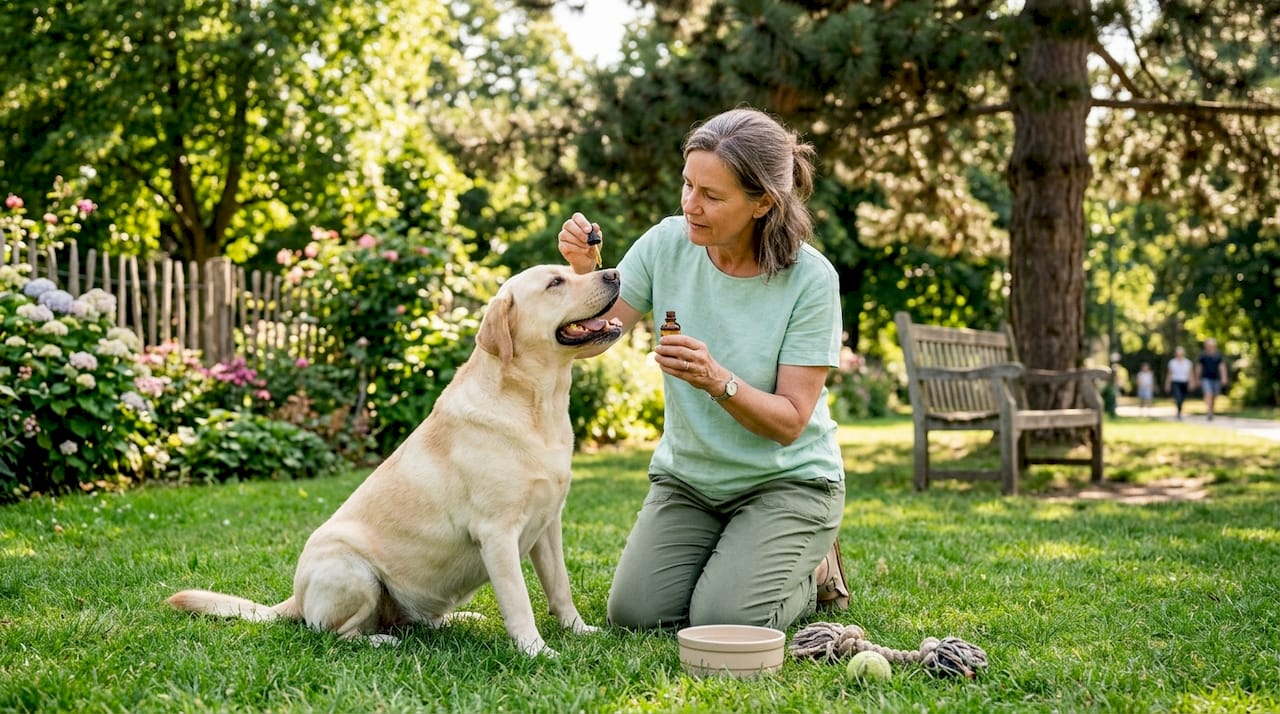
CBD acts on the serotonergic receptors of the endocannabinoid system to modulate stress responses in animals. This anxiolytic effect is particularly useful in specific situations: thunderstorms, fireworks, car journeys, visits to the vet, or moving house. Dogs suffering from separation anxiety often exhibit destructive behaviors or excessive vocalization, which CBD can alleviate.
The calming effect of CBD is not guaranteed for all animals. French veterinary behaviorists recommend combining it with improvements to the living environment. Here's how to effectively combine CBD and environmental management:
- Identify the specific triggers of your pet's anxiety (noise, loneliness, novelty).
- Administer CBD 30 to 60 minutes before the anticipated stressful event.
- Create a safe and quiet space where the animal can retreat.
- Maintaining a stable daily routine to reinforce the feeling of security.
- Consult a veterinary behaviorist if anxiety persists despite CBD.
In cats, anxiety often manifests as urine marking or withdrawal. CBD for cats is ideally administered mixed with food, starting with a very low dose. To delve deeper into this topic, Lord Of CBD's guide on CBD and canine anxiety details the mechanisms involved.
3. CBD as a support in chronic diseases and epilepsy
CBD reduces the frequency of epileptic seizures in some dogs, according to a clinical trial by McGrath et al. published in 2019 in the Journal of the American Veterinary Medical Association. This trial, involving 26 epileptic dogs, showed a significant decrease in seizures in animals receiving CBD in addition to their usual anti-epileptic medication. This result does not mean that CBD replaces anti-epileptic drugs; it acts as a complement.
In veterinary oncology, CBD is used to improve the comfort of animals receiving palliative care. It reduces nausea associated with chemotherapy and supports appetite. These effects remain complementary to established medical protocols.
CBD does not replace approved veterinary treatments. ANSES and the French Veterinary Association reiterate that its use should remain complementary and always be supervised by an animal health professional.
The precautions to be observed in this context are as follows:
- Always inform the veterinarian of any use of CBD alongside other treatments.
- Never interrupt a prescribed treatment to replace it with CBD.
- Monitor for the onset of excessive drowsiness or digestive problems.
- Request regular liver function tests for animals undergoing long-term treatment.
4. What precautions should be taken when using CBD in pets?
Dogs and cats are sensitive to THC, the psychoactive molecule in cannabis, which is toxic to them even in small doses. Any CBD product intended for animals must guarantee a near-zero THC content, confirmed by an independent Certificate of Analysis (COA). This traceability is the first check to perform before any purchase.
CBD can also alter the effectiveness of certain medications by interacting with liver metabolism. This interaction requires particular attention in animals undergoing chronic treatment. To better understand these risks, Lord Of CBD's page on CBD drug interactions provides detailed information.
| Risk | Symptom to watch for | Recommended action |
|---|---|---|
| Overdose | Excessive drowsiness, ataxia | Reduce the dose immediately |
| Poor quality | Digestive problems, vomiting | Change product, consult |
| Drug interaction | Loss of treatment effectiveness | Veterinary opinion required |
| Presence of THC | Tremors, disorientation | Veterinary emergency |
Excessive CBD consumption can cause drowsiness, digestive upset, or decreased appetite in sensitive animals. These side effects are usually reversible upon discontinuation or dose reduction.
Pro tip: Only choose products with a Certificate of Analysis (COA) available online and issued by an independent third-party laboratory. A manufacturer that doesn't publish its analyses offers no guarantee about the actual THC content.
5. Which CBD products should I choose and how should I administer them?
CBD oil is the most suitable form for pets. It allows for precise dosing and rapid absorption, either sublingually or mixed with food. CBD treats are a convenient alternative for reluctant pets, but their dosage is less adjustable. Products formulated for humans are not suitable for animals: the concentrations are unsuitable, and some excipients can be toxic to cats.
The dosage of CBD for dogs and cats is calculated according to the animal's weight. The typical veterinary protocol recommends starting between 0.5 and 2 mg per kilogram, twice a day, then adjusting after an observation period of 2 to 4 weeks.
- CBD oil: ideal for precise dosing, to be placed directly in the mouth or on food.
- CBD treats: convenient for daily administration, less flexible on dosage.
- Animal-specific products: always prefer formulations without THC, without toxic essential oils (tea tree, eucalyptus) and without xylitol.
- Progression: start with the minimum dose and increase in increments of 7 days maximum.
For cats in particular, liver metabolism differs from that of dogs. Felines eliminate certain molecules more slowly, increasing the risk of accumulation. A lower dose and closer monitoring are therefore necessary. Lord Of CBD's practical guide on administeringCBD oil to dogs details techniques to facilitate administration.
Key points
CBD acts on the endocannabinoid system of dogs and cats to relieve pain, reduce anxiety and improve comfort in chronic diseases, provided that THC-free products are used and a gradual dosage is followed under veterinary supervision.
| Point | Details |
|---|---|
| Endocannabinoid system | Dogs and cats possess this system, which makes CBD biologically active in them. |
| Pain and inflammation | CBD oil administered twice daily improves mobility in dogs with arthritis. |
| Anxiety | CBD alleviates situational stress, but must be combined with environmental management. |
| Epilepsy | CBD reduces the frequency of seizures when used in conjunction with prescribed antiepileptic drugs. |
| Security | Choose only products with independent COA and zero or near-zero THC content. |
What I've observed after years of monitoring the use of CBD in animal health
The question I'm most often asked by homeowners is, "Does it really work?" My answer is nuanced, and I think that nuance is precisely what's missing from most articles on the subject.
CBD works. But not for all animals, not for all conditions, and not in the same way for every individual. I've seen dogs with arthritis regain a level of mobility their owners had given up hope of ever seeing again. I've also seen animals show no noticeable response after six weeks of well-conducted treatment. This variability isn't a failure of CBD. It's the reality of any complementary approach in medicine.
What concerns me more is the tendency to use CBD as a substitute for veterinary diagnosis. A limping dog doesn't necessarily have arthritis. A hiding cat isn't necessarily anxious. Giving CBD without understanding the underlying cause is masking a symptom without treating the problem. CBD is a tool, not a diagnosis.
The other point I want to emphasize is that product quality makes all the difference. A poorly documented product with uncontrolled THC content can cause acute poisoning in a cat within hours. This isn't a theoretical risk. Requiring a current and legible Certificate of Analysis (COA) is the bare minimum, without exception.
— Daniel
Lord Of CBD for your pets: quality and safety guaranteed
Finding a reliable CBD product for your pet requires careful consideration. Lord Of CBD offers a selection of products made from organic hemp, with a THC content of less than 0.3% and accessible certificates of analysis for each product. Every product is formulated to meet the specific safety requirements for pets.
The Lord Of CBD team provides pet owners with personalized advice to help them choose the right formula and dosage based on their pet's weight and needs. premium CBD are available with fast delivery, and customer service is available to answer your questions before and after your purchase. For any questions specific to your pet, the team can be contacted directly through the contact page.
Frequently Asked Questions
Is CBD legal for animals in France?
CBD derived from hemp with less than 0.3% THC is legal in France. Its use in animals is not regulated like a veterinary medicine, but it must comply with ANSES recommendations.
What dose of CBD should I give my dog or cat?
The veterinary protocol recommends starting at 0.5 to 2 mg per kilogram of body weight, twice daily, and assessing the response after 2 to 4 weeks before any adjustment.
Can CBD replace my pet's veterinary treatment?
No. CBD is a supplement, never a substitute. ANSES and the French Veterinary Association remind us that any use must be supervised by a professional and must not interrupt prescribed treatment.
What side effects should I watch for in my pet?
The most common side effects are drowsiness, digestive problems, and loss of appetite. These usually occur in cases of overdose or poor-quality product and disappear when the dose is reduced.
How do I choose a good CBD product for my pet?
Check that the product has a Certificate of Analysis (COA) issued by an independent laboratory, that the THC content is zero or almost zero, and that the formulation is specifically designed for animals, without toxic excipients.