


Brazil has taken a decisive step toward modernizing its cannabis policy. In December 2024, the Superior Court of Justice (STJ) ruled in favor of the cultivation, processing, and sale of hemp for medical purposes, marking a significant break with the repressive policies of the past. This decision positions the South American giant as a future major player in the global medical cannabis market.
📌 The legal context and scope of the decision
The STJ's decision didn't come out of nowhere: it's the result of several years of pressure from patients, chronic illness associations, and entrepreneurs. Until now, Brazilian regulations—enforced by ANVISA (National Health Surveillance Agency)—prohibited the importation of hemp seeds and any domestic cultivation, forcing patients to resort to expensive imported products or turn to illegal channels.
With this new legal direction, hemp containing less than 0.3% THC is no longer considered an illicit substance, as long as its use is strictly regulated for therapeutic purposes. In other words, Brazil is legalizing only non-psychoactive cannabis intended to relieve patients' symptoms.
Judge Regina Helena Costa justified her decision by stating that restricting hemp cultivation infringed upon the constitutional right to health. This strong legal precedent could serve as a basis for similar legal challenges in other Latin American countries.
💊 A direct impact on the medical sector
Legalizing hemp for medical use opens the door to an immediate improvement in access to care for thousands of Brazilians suffering from chronic conditions: neuropathic pain, epilepsy, multiple sclerosis, sleep disorders, severe anxiety…
Until now, patients often needed special authorization to import CBD products, which represented a significant financial burden (up to $500 USD/month for some treatments). With the legalization of local cultivation, prices could quickly decrease, while also improving the quality and traceability of distributed products.
📈 A colossal economic opportunity
From an economic perspective, this decision could stimulate a domestic market estimated at $185 million in 2024, according to figures reported by Newsweed. CBD, in particular, represents between 70 and 80% of the market, as it remains less regulated than THC.
Several startups, farmers, and pharmaceutical companies are already preparing to invest in this promising sector. Brazil has considerable advantages: a favorable climate, abundant arable land, a skilled workforce, and above all, growing local demand. In the medium term, the country could even become a key exporter of medical hemp to other South American countries, and perhaps even to Europe.
🧪 Research and innovation: exciting prospects
The legalization of cultivation also opens new horizons for Brazilian scientific research. Universities and medical institutes will now be able to conduct rigorous clinical studies on the applications of CBD in the treatment of complex pathologies.
This will also stimulate innovation in pharmaceutical formulation: sublingual oils, topical creams, capsules, therapeutic herbal teas, etc. Brazil could become a biotechnology hub specializing in medicinal cannabinoids.
⚠️ A still restrictive framework… for now
It is important to emphasize that this legislation does not include industrial uses of hemp. This means that it remains illegal to use hemp to manufacture textiles, building materials, food, or cosmetics made from fibers. This is a major difference compared to other countries such as the United States, Canada, or France.
However, many experts hope this decision is a first step towards broader legalization. According to economist Fernando Machado, an expert in agricultural sectors, “industrial hemp could generate thousands of jobs in rural Brazil, while also stimulating eco-responsible innovation.”.
🌍 A decision that reflects a global trend
Brazil thus joins a growing list of countries that are relaxing their legislation on hemp:
-
Germany : Full legalization of recreational cannabis in 2024.
-
Switzerland : Pilot projects for controlled cannabis sales in several cantons.
-
Thailand : liberalization of medicinal hemp and traditional uses.
This global trend is explained by the growing recognition of CBD's therapeutic benefits and the limitations of prohibitionist policies. Furthermore, the economic opportunities linked to sustainable agriculture and the bioeconomy make hemp very attractive.
🔎 Short and medium-term outlook
The Brazilian government has six months to put in place an operational regulatory framework, according to the STJ's decision. It will notably have to define:
-
The criteria for authorization of cultivation (geographic areas, licenses).
-
Quality standards for hemp-based medical products.
-
The obligations of traceability, labelling and control.
By 2026, we can expect rapid growth in the therapeutic hemp sector, with the arrival of new products on the market, wider access for patients and a strategic positioning of Brazil on the international stage.
In summary
-
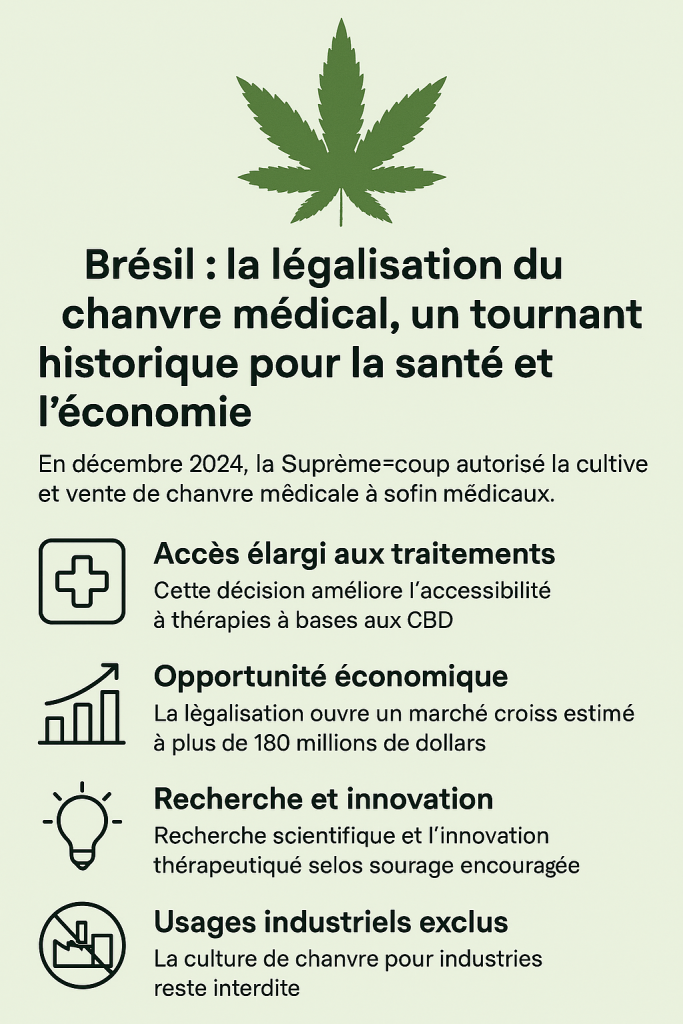
✅ Brazil’s Supreme Court has legalized the cultivation and sale of hemp for medical purposes (THC < 0.3%).
-
🏥 This decision improves patient access to CBD-based treatments.
-
💰 It opens up a market estimated at over $180 million, which is experiencing strong growth.
-
🔬 It stimulates scientific research and therapeutic innovation.
-
❌ Industrial uses of hemp remain excluded for the time being.
Brazil, with its natural resources and recent political will, could well become a key player in the green revolution of medical cannabis.