




Cannabidiol, or CBD, is a phytocannabinoid extracted from the Cannabis sativa , and a lab-produced version is now also available. While both forms share the same chemical formula, the differences between natural and synthetic CBD phytocannabinoids are significant and directly influence efficacy, dosage, and safety. Understanding these differences allows for informed choices, whether you're seeking general support for daily well-being or a more targeted effect. A comprehensive definition of CBD provides the essential foundation before delving deeper.
How are natural CBD and synthetic CBD produced?
Natural CBD originates in the trichomes of the Cannabis sativa, those small resinous glands visible on the surface of the flowers. The plant synthesizes cannabidiol via the MEP (methylerythritol-4-phosphate) pathway, a precise enzymatic cascade that produces molecules with a specific enantiomeric signature. This biological precision is the starting point for all the differences that follow.
Once the plant is harvested, CBD is extracted using various methods: supercritical CO₂, ethanol, or hemp oil. Each extraction method preserves, to varying degrees, associated compounds such as terpenes and flavonoids. The end result is an extract rich in natural cannabinoids, with a complex biochemical composition.

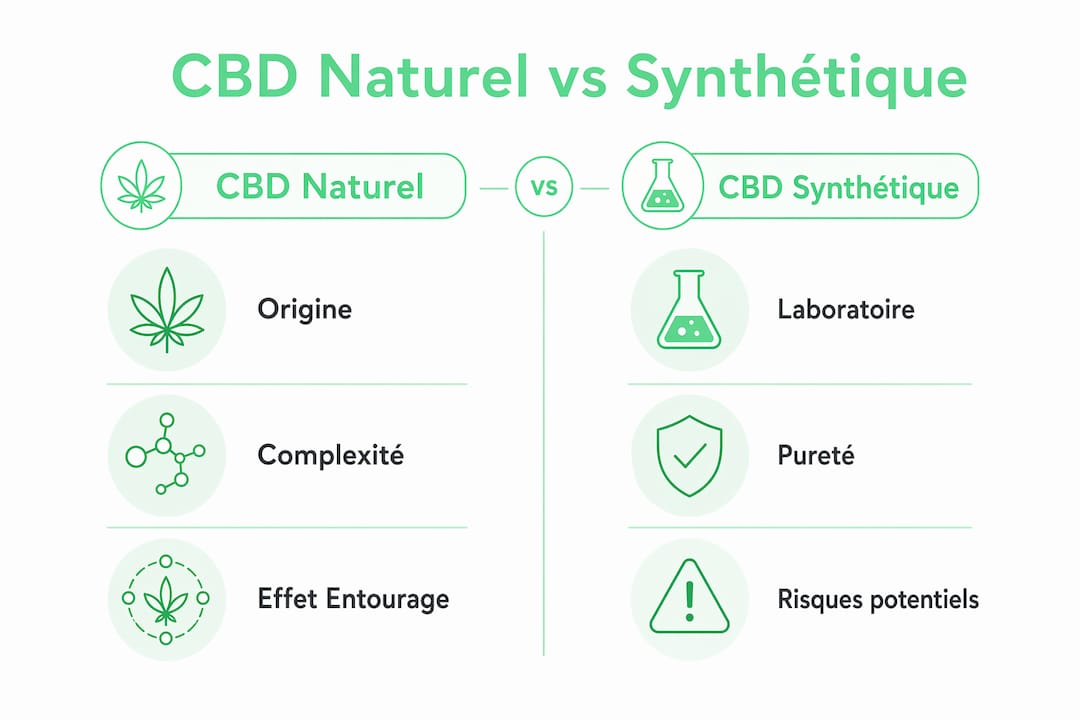
Synthetic CBD, on the other hand, is produced in the laboratory through chemical synthesis from organic precursors. This process yields a molecule of high molecular purity, free from traces of pesticides or heavy metals. However, industrial chemistry struggles to replicate the exact stereochemistry of natural CBD, often resulting in racemic mixtures—that is, mixtures of two mirror-image forms of the molecule, only one of which is biologically active.
Here are the main production differences to remember:
- Origin : Cannabis sativa plant for the natural version, chemical laboratory for the synthetic version.
- Composition : natural contains dozens of associated compounds; synthetic is an isolated molecule.
- Stereochemistry : the natural has a precise configuration; the synthetic may contain inactive isomers.
- Traceability : certified organic CBD guarantees the absence of synthetic pesticides and control of heavy metals via the Organic Agriculture label.
- Cost : synthetic materials are generally cheaper to produce on a large scale.
Pro tip: Always check whether the product you're buying is a full-spectrum extract, an isolate, or a chemical synthesis. This information is usually found on the product information sheet or in the lab results.
What are the chemical differences between natural and synthetic CBD?
The CBD molecule is identical in both cases: same chemical formula, same molecular weight. The difference lies in the stereochemistry and the molecular environment. Plant biosynthesis produces exclusively the active form, while industrial synthesis often generates a mixture of the two mirror forms, one of which is weakly or not at all active on cannabinoid receptors.
The entourage effect is the other major difference. Natural CBD works synergistically with the terpenes, flavonoids, and minor cannabinoids present in the plant. These compounds alter the binding to CB receptors in the brain, amplifying or modulating the overall effect. Synthetic CBD, being an isolated molecule, does not benefit from this effect.
Natural CBD reveals a biochemical richness inaccessible in synthesis, with dozens of minor compounds — flavonoids, rare cannabinoids and terpenes co-synthesized in the plant — that contribute to the overall experience and effects.
Pharmacological data strikingly confirm this difference. A recent study shows that synthetic CBD exhibits a bell curve response: its maximum effectiveness is reached at 25 mg/kg, then decreases at higher doses. Natural CBD, on the other hand, maintains or increases its effectiveness up to 150 mg/kg. In practical terms, this means that synthetic CBD is much more difficult to dose accurately.
| Criteria | Natural CBD | Synthetic CBD |
|---|---|---|
| Origin | Cannabis sativa plant | Chemical Laboratory |
| Stereochemistry | precise active form | Possible racemic mixture |
| Entourage effect | Present (terpenes, flavonoids) | Absent |
| Effective dose | 50–150 mg/kg (increasing dose-effect) | Optimal at 25 mg/kg (bell-shaped response) |
| Associated compounds | Dozens of minor cannabinoids | Isolated molecule only |
CBD also interacts with several biological targets: the CB1 and CB2 receptors of the endocannabinoid system, the 5-HT1A receptor linked to serotonin, and the liver enzymes CYP3A4 and CYP2C9. These pharmacological interactions are common to both forms, but their intensity varies depending on the composition of the product used.
What are the effects and limitations of each type of CBD?
Both natural and synthetic CBD act on the endocannabinoid system. Their general effects are similar: stress reduction, sleep support, and mild anti-inflammatory action. However, the differences in effectiveness are important for regular or therapeutic use.
Benefits of natural CBD:
- Synergy between compounds for a more complete and stable effect.
- Biochemical profile rich in rare cannabinoids and terpenes inaccessible in synthesis.
- Predictable and progressive dose-effect curve, facilitating personal adjustment.
- Enhanced traceability with organic certifications (AB label, EU certifications).
Advantages of synthetic CBD:
- High molecular purity, with no risk of plant contaminants.
- Lower production costs, therefore often cheaper to buy.
- Useful in contexts where natural contaminants pose a specific problem.
Limitations to be aware of:
- Synthetic drugs are difficult to dose correctly due to their bell-shaped response. Underdosing or overdosing reduces their effectiveness without the user noticing.
- Natural products may contain traces of pesticides or heavy metals if the crop is not certified organic.
- Both forms inhibit the liver enzymes CYP3A4 and CYP2C9, which can create interactions with certain medications.
Pro tip: Before increasing your dose, wait at least a week to assess the effects. The potential side effects of CBD vary depending on the form used and your individual profile.
Marketing claims often downplay the risks of CBD. A gradual approach is recommended, especially for those with pre-existing medical conditions or undergoing treatment. CBD is not a medicine and does not replace medical advice.
How to choose between natural and synthetic CBD depending on your needs?
The choice between natural and synthetic cannabidiol depends primarily on your goals and personal circumstances. Here is a practical guide to help you make your decision.
-
Define your goal. For general wellness use (stress, sleep, recovery), natural full-spectrum CBD offers the best overall experience thanks to the entourage effect. For highly targeted use or in a controlled medical setting, synthetic CBD can be considered under supervision.
-
Choose the right product profile. A full-spectrum extract contains all the plant's natural compounds. A natural CBD isolate is purified but retains the correct stereochemistry. Synthetic CBD is a molecule manufactured without associated compounds. The molecular structure of CBD explains why these distinctions matter.
-
Check the certifications and laboratory analyses. A quality product should be accompanied by a Certificate of Analysis (COA) issued by an independent laboratory. The Organic Agriculture label guarantees the absence of synthetic pesticides and the control of heavy metals.
-
Consider your individual tolerance. Everyone reacts differently to CBD. Start with a low dose and gradually increase it over several weeks. Consult the CBD toxicity profile if you are taking any medications.
-
Consult a healthcare professional if you have a medical condition. Healthcare professionals emphasize the need for a gradual introduction of CBD, even natural CBD, to assess tolerance and potential interactions, particularly with existing medical conditions or medications.
Key points
Natural CBD surpasses synthetic CBD in overall effectiveness thanks to the entourage effect, a stable dose-response curve, and precise stereochemistry absent in laboratory versions.
| Point | Details |
|---|---|
| Origin and composition | Natural CBD contains dozens of active compounds; synthetic CBD is an isolated molecule. |
| Entourage effect | Present only in natural CBD, it amplifies and modulates the therapeutic effects. |
| Dosage and effectiveness | Synthetics have a bell curve response (optimal at 25 mg/kg); naturals remain effective up to 150 mg/kg. |
| Quality and traceability | Certified organic CBD guarantees the absence of pesticides and contaminant control. |
| Practical choice | Define your goal, check the COAs and start with a low dose. |
My opinion after years of observing CBD consumers
The question of natural versus synthetic CBD comes up frequently, and I've noticed that most people who ask me this already have a correct intuition: natural CBD seems more reliable to them. This intuition is scientifically sound, but it deserves some nuance.
The real problem with synthetic CBD isn't that it's inherently "bad." It's that it's much more difficult to use correctly. The bell-shaped response makes dosing tricky for the average user without medical supervision. Too little has no effect. Too much has no effect either. This narrow therapeutic window is a real obstacle in everyday life.
Full-spectrum natural CBD, on the other hand, is more forgiving of dosage errors. Its gradual dose-response curve allows for adjustments. And the entourage effect, often presented as a marketing ploy, is actually a documented pharmacological reality. Terpenes aren't just there for the aroma: they actively modify how cannabinoids bind to receptors.
My advice is always to choose a certified organic natural product, check the Certificate of Authenticity (COA), and start slowly. The therapeutic benefits of CBD appear over time, not in a week. In theory, the quality of the product matters more than whether it's natural or synthetic.
— Daniel
Lord Of CBD's natural selection for an uncompromising choice
Lord Of CBD offers a range of CBD products made from certified organic hemp, with a THC content of less than 0.3%, in accordance with French regulations. Each product comes with independent laboratory analyses to guarantee its purity and exact composition.
Lord Of CBD's premium CBD flowers and resins are sourced from rigorously vetted producers, ensuring complete traceability from cultivation to delivery. Shipping is free, and personalized advice helps guide each customer to the product best suited to their needs. For those who wish to delve deeper, the guide on the benefits of CBD flower details specific uses and expected effects for different profiles.
Frequently Asked Questions
What is a phytocannabinoid?
A phytocannabinoid is a cannabinoid produced naturally by a plant, primarily Cannabis sativa. CBD, THC, and over a hundred other molecules belong to this family.
Is synthetic CBD legal in France?
The legal status of synthetic CBD in France depends on its exact composition and THC content. Only products containing less than 0.3% THC are authorized for sale, regardless of whether the CBD is of natural or synthetic origin.
Why is natural CBD more effective at higher doses?
Natural CBD maintains its effectiveness up to 150 mg/kg thanks to the entourage effect and its precise stereochemistry. Synthetic CBD, on the other hand, reaches its peak at 25 mg/kg and then loses effectiveness, which complicates dosage for everyday use.
How to check the quality of a natural CBD product?
Request a Certificate of Analysis (COA) issued by an independent laboratory. This document confirms the CBD content, the absence of pesticides, and the levels of heavy metals. An organic farming label further reinforces this guarantee.
Does CBD interact with medications?
Yes. CBD inhibits the liver enzymes CYP3A4 and CYP2C9, which can alter the metabolism of certain medications. If you are undergoing medical treatment, consult a healthcare professional before starting to use CBD in any form.