



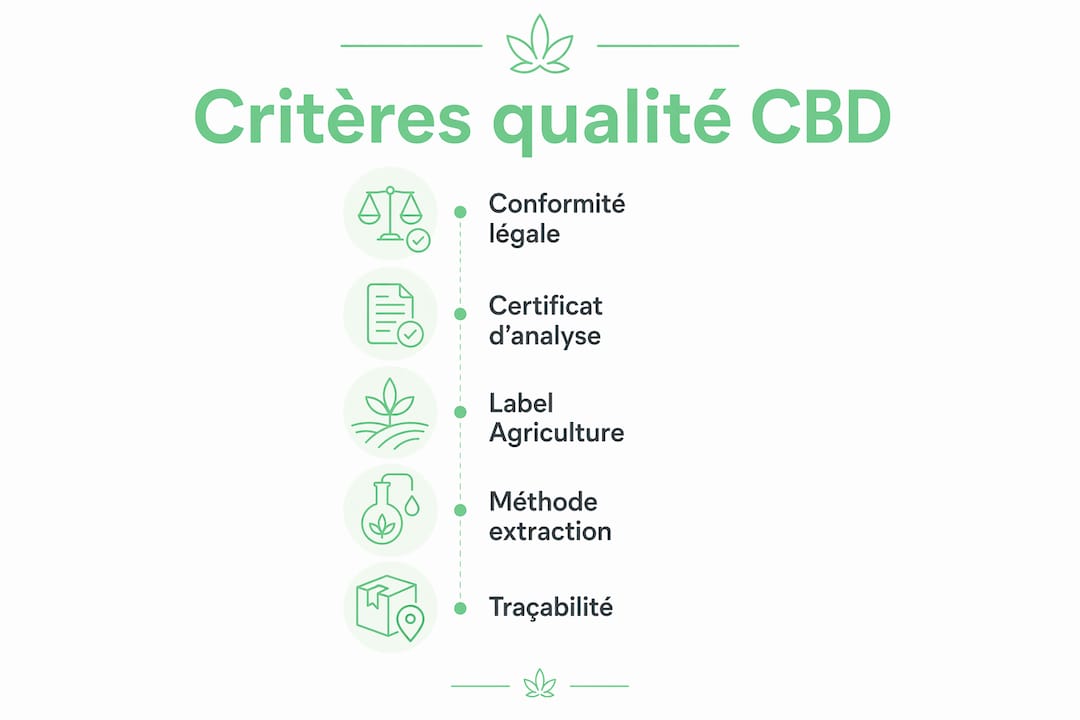
The CBD quality label in Europe is based on three fundamental criteria: compliance with the legal THC threshold of 0.3% or less, the presence of a Certificate of Analysis (COA) issued by an ISO 17025 accredited laboratory, and agricultural certification such as Organic Farming (AB). As of 2026, no official CBD-specific label exists at the European level. The true quality of a product is therefore measured by the combination of these three pillars, and not by a single statement on the packaging. Understanding these criteria protects your health and your budget.
What are the legal criteria that define the quality of CBD in Europe?
Legal compliance is the first filter to apply before any purchase. In Europe, all CBD products sold must have a THC content of 0.3% or less. This threshold protects the consumer from any psychoactive effects and guarantees the product's legality in almost all member states.
Beyond THC, CBD products intended for ingestion, such as oils or capsules, fall under the Novel Food classification defined by the European Union. This classification requires prior authorization from the EFSA (European Food Safety Authority) before they can be placed on the market. A product sold without this authorization is non-compliant, regardless of the quality of its hemp origin.
Labeling requirements constitute a third legal criterion. EU Regulation 1169/2011 mandates specific information on each package:
- The CBD and THC levels are expressed as a percentage or in milligrams
- The batch number allows for traceability
- The list of ingredients and the origin of the hemp
- Legal notices adapted to national legislation
In France, the DGCCRF (Directorate General for Competition Policy, Consumer Affairs and Fraud Control) monitors compliance with these obligations. A product without a batch number or without mentioning the THC content is an immediate red flag. While legal variations exist between Member States, these four requirements form the common framework applicable throughout Europe.
Pro tip: Check labeling requirements before buying. Incomplete labeling often indicates a lack of rigor throughout the production chain.
How to read a Certificate of Analysis (COA) to evaluate CBD?
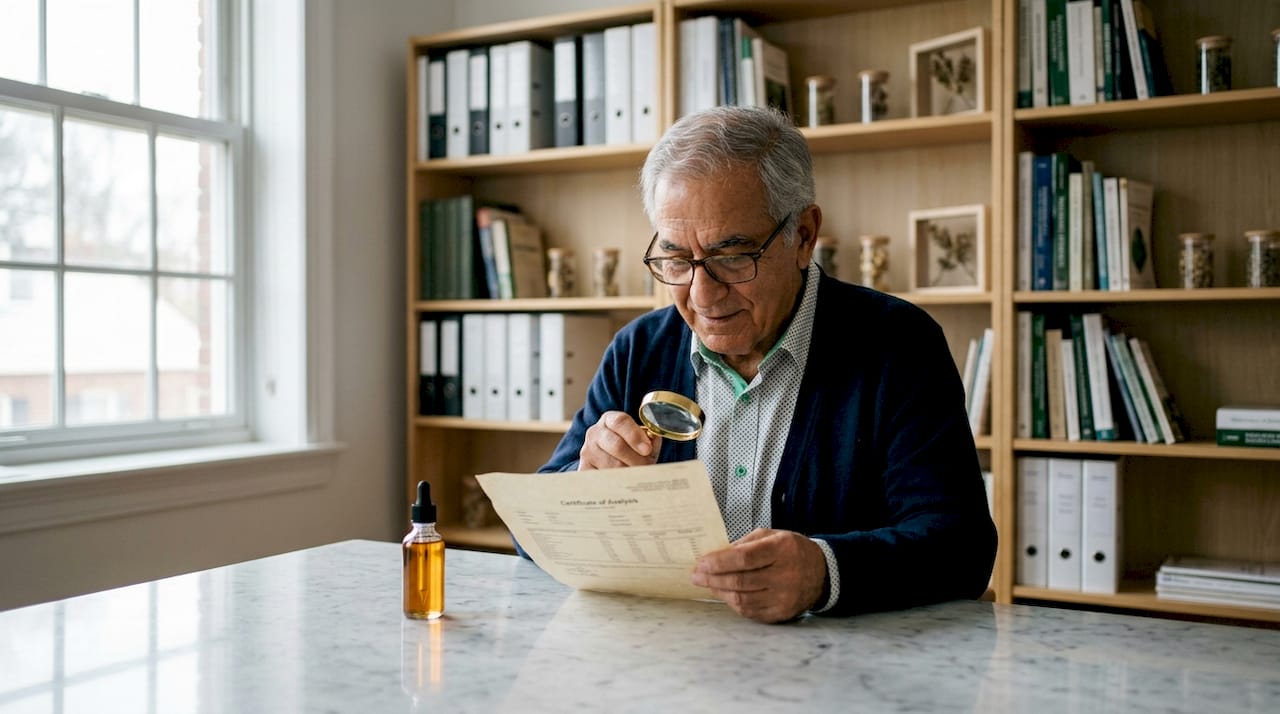
The certificate of analysis (COA) is the most reliable tool for assessing the true quality of a CBD product. The most reliable method of evaluation remains verification of the COA issued by an ISO 17025 accredited laboratory, which guarantees the laboratory's impartiality and technical competence. Without this accreditation, the results have no probative value.
A complete COA covers three distinct analytical blocks. The COA covers three essential blocks: the cannabinoid profile, chemical contaminants, and microbiological parameters. Each block answers a specific question about product safety.
Here's how to read each section:
- Cannabinoid profile : verifies the stated CBD level and confirms that THC remains below the legal limit of 0.3%. A discrepancy between the value displayed on the packaging and the Certificate of Analysis (COA) indicates a formulation problem or fraud.
- Chemical contaminants : testing for pesticides, heavy metals, and residual solvents. This section is critical because hemp is a bioaccumulator of soil pollutants.
- Microbiological parameters : monitors for the presence of bacteria, mold, or yeast. A poorly stored or improperly extracted product can present real microbiological risks.
| COA Section | What she checks | Alertness threshold |
|---|---|---|
| Cannabinoid Profile | CBD and THC levels | THC ≤ 0.3% |
| Chemical contaminants | Pesticides, heavy metals, solvents | Absence or traces in accordance with EU standards |
| Microbiology | Bacteria, molds, yeasts | Absence of pathogens |
A Certificate of Authenticity (COA) only guarantees complete safety if it is dated, lot-numbered , and issued by a recognized accredited laboratory. A generic COA, valid for an entire range without a specific lot number, proves nothing about the product you are holding.
Pro tip: Always compare the batch number printed on your packaging with the one on the Certificate of Authenticity (COA). If they differ, the certificate does not apply to your product. See the Certification and Legal Sale to understand what this means in practice.
What role does the Organic Agriculture label play in the quality of CBD?
The Organic Agriculture (AB) label certifies the growing conditions of the hemp, not the quality of the finished product. This distinction is crucial. The AB label certifies only the cultivation, not the purity or safety of the processed CBD. Therefore, a product derived from organic hemp can contain contaminants if the processing stages are not controlled.
Hemp is a bioaccumulator of pollutants. Organic cultivation without pesticides alone does not guarantee CBD free of heavy metals. If the soil is contaminated, hemp will absorb these pollutants, even when organically grown. Therefore, laboratory analysis of the finished product remains essential, even for certified organic (AB) products.
The actual guarantees of the AB label include:
- The absence of synthetic pesticides and GMOs in the crop
- Compliance with good European agricultural practices
- An annual audit by an accredited certification body (Ecocert, Bureau Veritas, etc.)
These guarantees are useful but insufficient on their own. For a complete assessment, the AB label must be combined with manufacturing standards such as ISO 22000 (food safety) or Good Manufacturing Practices (GMP), equivalent to international GMPs. These standards govern the processing of hemp into finished products and fill the gap left by the agricultural label.
Pro tip: Be wary of "organic" claims without a visible AB certificate. This marketing claim has no regulatory value. No "premium" marketing claim can replace a Certificate of Achievement (COA) and recognized certifications.
What extraction processes influence the final quality of CBD?
The extraction method directly determines the purity and safety of the final product. Supercritical CO2 extraction is considered the gold standard for ensuring purity and avoiding chemical solvent residues. This process uses pressurized carbon dioxide to extract cannabinoids without introducing harmful substances.
Alternative methods present specific risks:
- Extraction with chemical solvents (butane, hexane): leaves potentially toxic residues if the purging is incomplete. These solvents must be listed in the Certificate of Analysis (COA) under the section "residual solvents".
- Ethanol extraction : less risky than petroleum solvents, but can lead to terpene degradation if the temperature is not controlled.
- Cold extraction : preserves terpenes and flavonoids, but produces a less concentrated extract.
The form of the final product also influences perceived quality. Full-spectrum CBD contains all the cannabinoids, terpenes, and flavonoids of hemp, including trace amounts of THC below the legal limit. Broad-spectrum CBD is similar but without detectable THC. CBD isolate is over 99% pure but lacks the additional compounds. For different extraction methods, each produces a different analytical profile that the Certificate of Analysis (COA) must accurately reflect.
Traceability of the raw material completes this picture. A reputable manufacturer indicates the geographical origin of the hemp, the variety cultivated, and the harvest batch number. This information makes it possible to link each finished product to its agricultural source and to verify the consistency between the Certificate of Origin (COA) and the label.
How to choose a reliable CBD supplier or product in Europe?
Choosing a reliable CBD product relies on a methodical check of five concrete points. A brand's transparency is measured by the public and accessible availability of detailed Certificates of Analysis (COAs) for each batch. A brand that hides its COAs or only provides them upon request warrants caution.
- Verify the lot-specific COA : request the certificate that corresponds exactly to your product's lot number. A generic COA proves nothing.
- Check the laboratory's accreditation : the laboratory must be ISO 17025 accredited. Verify its name and accreditation number on the COFRAC (France) website or the equivalent national body.
- Read the entire label : CBD content, THC content, batch number, hemp origin, and legal information must all be included. Consult the supplier selection criteria for a complete overview.
- Assess transparency regarding extraction : a reputable supplier will specify the extraction method used. Supercritical CO2 extraction remains the gold standard.
- Identifying warning signs : abnormally low price, lack of accessible COA, unauthorized health claims (“cures”, “treats”) and lack of batch number are indicators of non-compliance.
Pro tip: A very low price for a so-called premium CBD resin should raise a red flag. Analytical quality has a real cost: laboratory accreditation, CO2 extraction, agricultural certifications. A product sold at a rock-bottom price cannot afford these guarantees.
Key points
Quality CBD in Europe is assessed by the combination of an ISO 17025 accredited COA, compliance with the legal THC threshold of 0.3%, and agricultural certifications verified by analyses on the finished product.
| Point | Details |
|---|---|
| Legal THC threshold | All CBD products must have a THC content ≤ 0.3% to be legal in Europe. |
| COA accredited to ISO 17025 | The certificate of analysis must be dated, linked to the batch number and issued by an accredited laboratory. |
| AB label and its limitations | The Organic Agriculture label certifies the cultivation, not the purity of the processed product. |
| CO2 extraction | Supercritical CO2 extraction guarantees the absence of residual solvents in the final product. |
| Warning signs | Prices that are too low, missing or generic COA, and unauthorized health claims indicate an unreliable product. |
What years of observing the CBD market have taught me about transparency
The European CBD market suffers from a paradox: the more marketing claims a package contains, the less analytically documented the product itself. I've seen dozens of products labeled "premium," "organic," and "full spectrum" without a single publicly available Certificate of Analysis (COA). This is the opposite of what transparency should be.
The uncomfortable truth is that consumers must develop a critical eye and prioritize analytical transparency to ensure the quality and safety of CBD. It's not the consumer's job to do the regulator's work, but as of 2026, the European regulatory framework remains incomplete regarding CBD-specific labeling. Therefore, personal vigilance remains the best tool available.
What has struck me most over time is that truly reputable brands publish their Certificates of Analysis (COAs) without being asked, link them to each production batch, and indicate the name of the laboratory. They aren't afraid of verification. The others rely on marketing ploys to compensate for the lack of analytical evidence.
My advice for 2026 is simple. Treat the Certificate of Agriculture (COA) as the product's identity document. If it's missing, generic, or undated, the product lacks verifiable identity. No agricultural certification, however prestigious, can compensate for this deficiency. The combination of an accredited COA, an organic label (AB), and a documented extraction method remains the only true quality standard in this market.
— Daniel
Lord Of CBD and the quality guarantee on every product
Lord Of CBD selects its producers based on strict criteria: organic hemp of European origin, documented extraction, and accessible certificates of analysis for each batch. premium CBD includes resins and flowers whose THC content consistently remains below the legal threshold of 0.3%. Each product comes with a Certificate of Analysis (COA) issued by an accredited laboratory, which can be viewed directly on the product pages. For consumers who wish to verify the analyses before purchasing, the Lord Of CBD team answers all questions regarding origin, extraction, and certifications. Transparency is not an option; it is the foundation of every product offered.
Frequently Asked Questions
What is a CBD quality label in Europe?
In Europe, no official label specific to CBD exists in 2026. Quality is assessed by the combination of the ISO 17025 accredited COA, compliance with the legal THC threshold of 0.3% and agricultural certifications such as the AB label.
How can I verify that a COA is valid?
A valid COA includes the batch number of the purchased product, a recent date, and the name of an ISO 17025 accredited laboratory. Verify the laboratory's accreditation on the official register of COFRAC or the equivalent body in your country.
Does the Organic Agriculture label guarantee the purity of CBD?
No. The AB label only certifies the growing conditions of the hemp, not the purity of the processed product. Laboratory analyses of the finished product remain essential to confirm the absence of heavy metals and contaminants.
Which extraction method should I choose for quality CBD?
Supercritical CO2 extraction is the reference method. It guarantees the absence of residual solvents and preserves the cannabinoids and terpenes of hemp without introducing harmful substances into the final product.
What are the main warning signs when buying CBD?
An abnormally low price, the absence of an accessible and batch-linked COA, unauthorized health claims, and incomplete labeling are the four most reliable warning signs for identifying a non-compliant product.