



CBD product certification is the primary requirement for guaranteeing their legality for sale in France. A cannabidiol (CBD) product can only be legally marketed if its THC (tetrahydrocannabinol) content in the finished product remains at or below 0.3%, the threshold set by French law. Exceeding this threshold exposes the seller to criminal penalties of up to 10 years imprisonment and a fine of €7.5 million. Therefore, CBD product certification for legal sale relies on precise documentation, accredited laboratories, and recognized standards. Understanding these requirements protects both the buyer and the seller.
What certifications are essential for the legality of CBD products?
The central certification in the CBD industry is the Certificate of Analysis (COA). This document attests, batch by batch, to the exact composition of the product. A valid COA must be issued by an independent laboratory accredited according to ISO 17025 and must cover, at a minimum, cannabinoid profiles, the detection of contaminants such as heavy metals, pesticides, and residual solvents, as well as the precise identification of the analyzed batch.
Here are the certifications and standards you need to know to sell or buy CBD in full compliance:
- COA ISO 17025 : the basic document, mandatory for all CBD products placed on the market. It proves that the THC level complies with the legal limit and that the product is free of harmful contaminants.
- AFNOR SPEC 903 standard : the recommended French standard for best practices in hemp cultivation and processing. It is not mandatory, but reputable distributors and regulatory authorities highly value it during inspections.
- Organic Farming (AB) certification : guarantees the absence of synthetic pesticides in the crop. It does not cover THC levels or contaminants in the finished product. It complements the Certificate of Agriculture (COA) but does not replace it.
- European Novel Food Status : For CBD products intended for food, European regulations impose strict traceability requirements and a mandatory Certificate of Analysis (COA). No CBD food product has yet received official marketing authorization in Europe
Pro tip: Don't settle for just one certification. The combination of ISO 17025 COA and AB certification offers the strongest coverage to reassure buyers and authorities.
The AFNOR SPEC 903 standard is particularly valued by professionals who anticipate stricter regulations. Complying with it today positions you favorably for tomorrow. By 2026, inspections will be more stringent, and those who rely on multiple levels of certification are significantly less exposed to litigation.

How to verify the validity of a CBD analysis certificate?
A reliable Certificate of Authorization (COA) can be identified by several specific elements. The document must include the COFRAC (French Accreditation Committee) accreditation number or a recognized European equivalent. This information allows verification of the issuing laboratory's legitimacy directly on the COFRAC public register.
The mandatory elements of a reliable COA are as follows:
- Batch identification : a unique number that links the document to the exact product analyzed.
- Cannabinoid profile : levels of CBD, THC, CBG, CBN and other cannabinoids present.
- Contaminant testing : heavy metals, pesticides, mycotoxins, residual solvents.
- Date of issue : A COA must be recent and specific to each batch. A generic or undated document is invalid.
- Laboratory accreditation number : COFRAC or equivalent recognized ISO 17025.
Pro tip: Always check the date of the COA. A certificate that is more than a year old or does not correspond to the lot for sale has no legal value.
There is no harmonized public label for CBD at the European level. This absence creates fertile ground for marketing labels lacking scientific basis. Claims such as “premium certified” or “quality guaranteed” without an accompanying Certificate of Analysis (COA) constitute no proof of conformity. Complete traceability of the product, from seed producer to consumer, remains the only reliable guarantee. A savvy buyer always requests the COA specific to their product batch, not a generic document displayed on a website.

What steps should be followed for a legal and certified CBD sale?
Selling CBD legally in France in 2026 follows a structured process. Here are the steps to follow in order:
-
Select a certified supplier. The producer must use hemp varieties listed in the European catalogue and provide an ISO 17025 Certificate of Authenticity (COA) for each batch. Requiring these documents before placing any order is non-negotiable.
-
Obtain and retain the Certificate of Analysis (COA) for each batch. The certificate must correspond exactly to the batch received. Complete traceability of hemp, from seed producer to final product, is a legal requirement. Keeping this evidence allows you to respond to any administrative or customs inspection.
-
Comply with labeling regulations. In accordance with the decree of June 22, 2023, all CBD products must clearly display their THC and CBD levels on the packaging. This information informs the consumer and facilitates inspections.
-
All medical claims are prohibited. CBD products may not be presented as treating any disease or health condition. Unauthorized medical claims expose the seller to prosecution for practicing medicine without a license or engaging in deceptive business practices.
-
Anticipate inspections. Keep a complete file for each batch sold: Certificate of Analysis (COA), supplier invoices, and compliant product sheets. This file constitutes the first line of defense in the event of an inspection.
Following these five steps drastically reduces the risk of penalties. French authorities have strengthened their controls on physical and online points of sale since 2024.
What risks and mistakes should be avoided when buying or selling certified CBD?
Several recurring pitfalls expose buyers and sellers to serious problems. Knowing them allows you to avoid them.
- Do not rely solely on the organic label. Organic certification applies to cultivation methods, not to the THC content or contaminants in the finished product. An organic product can certainly exceed the legal THC limit. A Certificate of Authenticity (COA) remains essential in addition to the organic certification.
- Accepting a Certificate of Analysis (COA) from a non-accredited laboratory is not acceptable. A laboratory without a COFRAC number or ISO 17025 accreditation does not produce a legally valid document. This type of certificate offers no protection to either the seller or the buyer.
- Using a generic or expired COA is not recommended. Certificates of analysis must be dated and specific to each batch. An undated document or one covering several different batches is a practice that few operators fully comply with, but it represents a major legal weakness.
- Don't confuse food labels with legal certifications. A generic food quality label does not replace a CBD Certificate of Authenticity (COA). These two types of documents meet distinct requirements.
- Publishing therapeutic claims. Presenting a CBD product as a remedy for anxiety, pain, or insomnia is an offense. French authorities are increasingly penalizing these practices.
A CBD product without a recent Certificate of Authenticity (COA) and full traceability is not a certified product. It is a risky product for both the seller and the buyer.
To avoid contaminants in low-quality products, checking the Certificate of Authenticity (COA) before purchase is the only reliable method. Products with THC levels exceeding the legal limit are confiscated, and their sale results in serious criminal prosecution.
Key points
The legality of a CBD product rests on three pillars: an ISO 17025 COA per batch, a THC level less than or equal to 0.3%, and complete traceability from hemp to finished product.
| Point | Details |
|---|---|
| COA ISO 17025 mandatory | Each batch sold must be accompanied by a certificate of analysis issued by an accredited laboratory. |
| Legal threshold THC ≤ 0.3% | Exceeding this threshold exposes the seller to criminal penalties of up to 10 years in prison. |
| AFNOR SPEC 903 standard | This voluntary French standard is a strong signal of seriousness for distributors and authorities. |
| Labeling compliant | The decree of June 22, 2023 requires that the THC and CBD levels be clearly displayed on each product. |
| The organic label is not enough | The AB certification covers the cultivation, not the THC level or contaminants in the finished product. |
What I've learned about CBD certifications after years in the industry
The question I get asked most often is: “Is an organic label enough to guarantee safety?” The answer is no, and this confusion still causes a lot of problems. The organic farming label is good for the planet and for agriculture. But it says nothing about the THC level of the finished product, nor about the possible presence of heavy metals or residual solvents.
What struck me when observing the market was the complete absence of a harmonized public label at the European level. Each player builds its own communication around private certifications, some of which are legitimate, others purely marketing-oriented. The only reliable guide remains the Certificate of Authenticity (COA) issued by a COFRAC or ISO 17025 accredited laboratory, dated and specific to the purchased batch.
In my opinion, the AFNOR SPEC 903 standard is the best signal of professionalism a company can send. It's not mandatory, but those who comply with it demonstrate that they are proactive in anticipating regulatory changes rather than reacting to them. This is an approach I strongly encourage.
My most practical advice: before buying or listing a CBD product, ask for the Certificate of Analysis (COA) for the exact batch. If the seller can't provide it immediately, walk away. Transparency on this point isn't optional; it's the bare minimum expected of a reputable business in 2026.
— Daniel
Lord Of CBD's certified CBD products
Lord Of CBD applies these requirements to every product in its range. Each batch comes with a certificate of analysis issued by an accredited independent laboratory, with a THC level consistently below 0.3%. Partner producers are selected according to strict traceability criteria and compliance with French regulations.
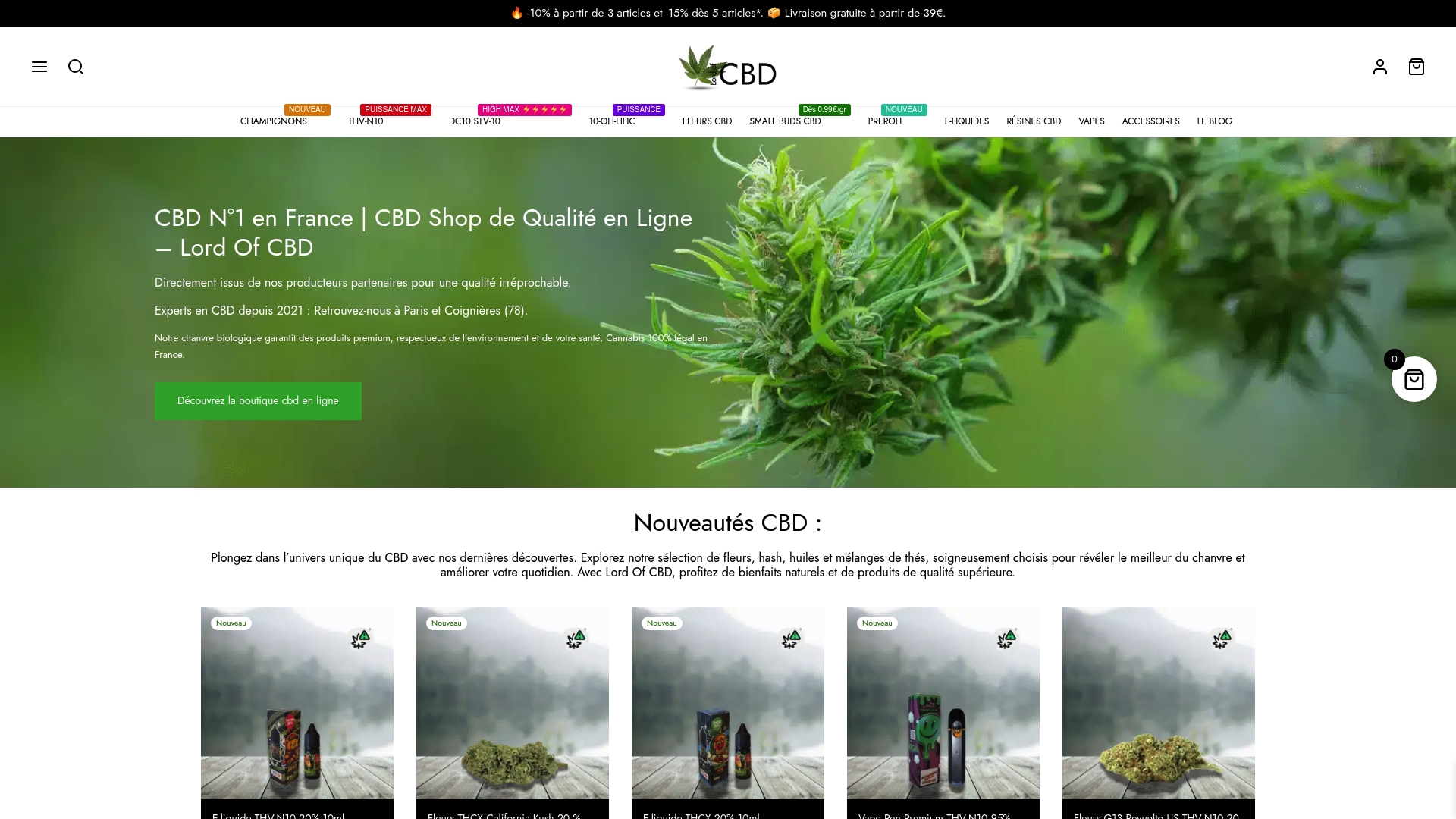
Laboratory analyses are available directly on the website for each listed product. Whether you're looking for flowers, resins, or oils, the selection available on the CBD Versailles page includes legal, inspected products that comply with current standards. Choosing Lord Of CBD means choosing a shop that makes certification clear and accessible, without you having to search for compliance documents yourself.
Frequently Asked Questions
What is a COA for a CBD product?
A COA (Certificate of Analysis) is a certificate of analysis issued by an independent laboratory accredited to ISO 17025. It confirms the cannabinoid level, the absence of contaminants, and the identification of the analyzed batch.
Is the organic label sufficient to guarantee the legality of CBD?
No. Organic farming certification only covers cultivation practices and does not guarantee that the THC level of the finished product complies with the legal limit of 0.3%. A Certificate of Achievement (COA) is always required in addition.
What penalties do you risk for selling non-compliant CBD?
The sale of CBD with a THC level exceeding 0.3% exposes the seller to criminal penalties of up to 10 years in prison and a fine of 7.5 million euros according to article 222-37 of the Penal Code.
How can I verify that a COA is authentic?
Check for the presence of the laboratory's COFRAC or ISO 17025 accreditation number, the issue date, and the batch number corresponding to the purchased product. This information can be verified in the COFRAC public register.
Can medical claims be made about a CBD product?
No. Presenting a CBD product as a medical treatment is prohibited in France and exposes the seller to prosecution for illegally practicing medicine or deceptive business practices.