



The European CBD regulation in 2026 establishes a strict framework that prohibits cannabidiol-based food supplements, sets a provisional safety threshold of approximately 2 mg per day of pure CBD according to the EFSA, and imposes strengthened national controls. This framework, often summarized as “European CBD regulation 2026 explained,” does not constitute complete harmonization. It is a fragmented sector-specific framework, where each member state retains significant room for interpretation. Professionals and individuals must understand these rules to act in compliance, whether for consuming, distributing, or opening a CBD shop in Europe.
Which CBD products are allowed or banned in Europe in 2026?
The legal status of a CBD product depends primarily on its category. The European Union does not treat CBD as a single substance subject to a single regulation. It assesses it according to the type of finished product and its declared use.
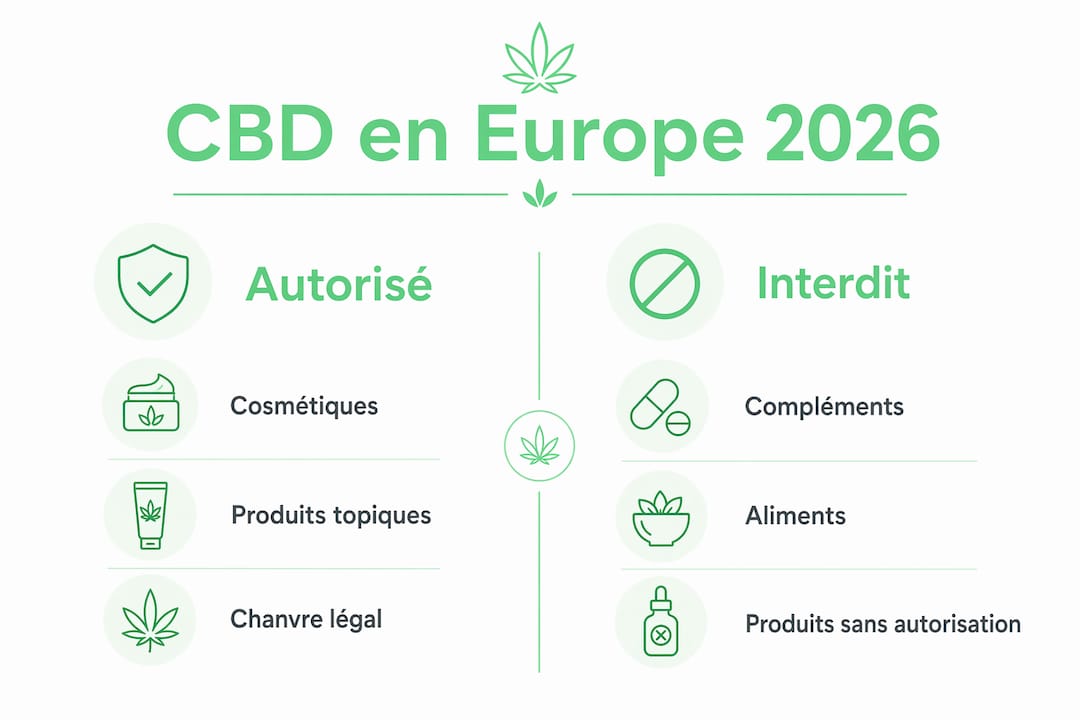
CBD-based food supplements are not authorized for sale in the European Union. Applications submitted by manufacturers are still under review by the EFSA (European Food Safety Authority), and no Novel Food authorization has been granted to date. This de facto ban directly affects oils, capsules, and other ingestible products marketed as supplements.

CBD-based cosmetics remain permitted in most member states, provided they comply with the general rules of the European cosmetics regulation. E-liquids for electronic cigarettes occupy a grey area: their legality varies depending on the country and the concentration. Flowers and smokable products are subject to the strictest restrictions, with total bans in some countries.
| Product type | Status in Europe in 2026 |
|---|---|
| Dietary supplements | Prohibited (No Novel Food authorization) |
| Cosmetics | Allowed under certain conditions |
| E-liquids | Varies by country |
| Flowers and smokable products | Restricted or prohibited depending on the state |
| Food extracts and oils | Pending EFSA authorization |
Pro tip: Always check the regulatory category of each product before selling it. The same CBD extract can be legal as a cosmetic and illegal as a food supplement in the same country.
How does CBD regulation vary across European countries?
The European framework sets a maximum THC level of 0.2% or 0.3% depending on the member state, but its practical application varies considerably from one country to another. This fragmentation is the main source of confusion for distributors and consumers operating across Europe.
Here are the main differences to know between countries:
- In France , the permitted THC level has been set at 0.3% since 2021. The sale of CBD flowers is legal, but their consumption by smoking remains subject to administrative tolerance. The DGCCRF (French Directorate General for Competition Policy, Consumer Affairs and Fraud Control) and the DGAL (French Directorate General for Food) actively monitor food products.
- Belgium : regulations are more restrictive. CBD products in Belgium are subject to increased monitoring, and the sale of flowers is often challenged by local authorities.
- Germany : Since the 2024 reform, the legalization of CBD in Germany has evolved towards greater tolerance for products for personal use, but the commercial framework remains regulated.
European regulations alone are insufficient to assess the actual operational risk. Local administrative practices and effective controls must be analyzed on a country-by-country basis. A product compliant with French regulations may be seized at the Belgian or Dutch border. This reality necessitates constant legal monitoring for all players in the European CBD market.
What sanctions and controls will be in place in 2026?
Since mid-May 2026, the DGAL (Directorate General for Food) has implemented a strict national control plan targeting all food products containing cannabinoids. This plan mandates withdrawals and recalls of non-compliant products, with direct consequences for retailers.
The distinction between withdrawal and recall is fundamental for any professional:
- The recall only affects the distribution chain. The product is being removed from shelves and warehouses, without any mandatory public announcement.
- A recall requires public communication to end consumers. It applies when non-compliant products have already reached the retail market.
- Criminal penalties can target the company's director personally, not just the company. Ignoring a recall procedure exposes one to direct prosecution.
- Documentary traceability is a requirement, not a recommendation. Each batch must be traceable from production to sale, with evidence kept and accessible in case of inspection.
Traders must retain all analytical evidence and traceability documents. In the event of an inspection by the DGAL or DGCCRF, the absence of documentation is treated as non-compliance, even if the product itself meets the permitted limits.
Pro tip: Create a compliance file for each product, including certificates of analysis, supplier datasheets, and proof of traceability. This file must be updated for each new batch.
What are the challenges of opening or managing a CBD shop in Europe in 2026?
Opening a CBD shop in Europe in 2026 remains possible, but several practical obstacles are hindering new entrants. The most frequent mistakes when opening a CBD shop in Europe concern defining the business purpose and accessing bank financing.
Banks remain hesitant to finance CBD activities despite their legality in France. This reluctance stems not from a legal prohibition but from a perceived reputational risk. The most effective solution is to broaden the company's scope to include wellness and relaxation products, rather than limiting it to CBD alone. Explicitly mentioning compliance with CBD legislation in the business plan reassures financial institutions.
France offers a real competitive advantage for local retailers. France produces approximately 60% of European hemp, which reduces logistics costs and improves the availability of raw materials. This advantage translates directly into higher margins and shorter supply times for French shops compared to their European counterparts.
Practices to absolutely avoid include:
- Selling products without up-to-date certificates of analysis from accredited laboratories.
- Displaying health claims on CBD products, which is prohibited by the European regulation on nutrition and health claims.
- Ignoring national labeling rules, which differ from general European rules in several countries.
- Underestimating the costs of regulatory compliance, which include laboratory analyses, legal advice, and staff training.
legislation in France is constantly evolving. Monthly monitoring of official publications from the DGAL, DGCCRF, and ANSM is essential to remain compliant.
How can we anticipate future regulatory changes?
The 2026 European framework does not promise complete harmonization. It establishes a strengthened sectoral framework that secures some segments while excluding others. CBD market players must integrate this structural uncertainty into their business model.
Professionalization through analytical evidence is becoming a central requirement. Businesses must anticipate increased rigor in analytical and toxicological reporting, as well as quality control. Operators who invest in these processes now will be better positioned when regulations become even stricter.
European CBD regulations are evolving in successive stages, not through sudden revolutions. Companies that build their compliance on solid evidence today will withstand the next waves of scrutiny, regardless of their scale.
Monitoring legal developments on a country-by-country basis remains the only reliable approach. The principle of CBD legality is poorly understood by many stakeholders: marketing depends not only on European law, but also on national specificities and the type of product involved. A court ruling in Italy or an administrative circular in Austria can alter the operational landscape for a French distributor that exports.
Anticipated trends for 2027 and beyond include the possible partial authorization of food supplements if the EFSA approves certain Novel Food dossiers, and stricter controls at internal borders within the Schengen Area for CBD products. Anticipating these developments means preparing the compliance dossiers that will be required tomorrow.
Key points
The European regulation of CBD in 2026 imposes a fragmented framework by country and by type of product, where compliance requires rigorous documentation and constant legal monitoring.
| Point | Details |
|---|---|
| Dietary supplements are prohibited | No Novel Food authorization has been issued; their sale is illegal throughout the EU. |
| EFSA threshold at 2 mg/day | This provisional threshold is much lower than the dosages commonly found on the market, which weakens many products. |
| National fragmentation | The permitted THC level and the rules on flowers vary according to each Member State. |
| DGAL controls since May 2026 | Withdrawals and recalls are now systematic for non-compliant food products in France. |
| French advantage over hemp | France produces approximately 60% of European hemp, reducing costs for local traders. |
What I observe on the ground after years of following this market
The European CBD regulation 2026 is often presented as an obstacle. I see it differently. It's a filter that eliminates unserious players and strengthens the credibility of those who play by the rules of compliance.
What strikes me most is the number of professionals who underestimate the difference between a withdrawal and a recall. I've seen retailers treat a recall as a simple stock withdrawal, without any public communication, and end up facing personal criminal penalties. This mistake is avoidable with basic training on DGAL procedures.
The other blind spot concerns health claims. Many CBD shops continue to display therapeutic claims on their products, which is prohibited by European regulations. This isn't a gray area; it's a direct violation that can lead to the administrative closure of a retail outlet.
My most practical advice: treat compliance as an investment, not a constraint. Companies that rigorously document their products today are building a lasting advantage. The European CBD market is becoming more professional. Those who anticipate this evolution will emerge stronger.
— Daniel
Lord Of Cbd supports you in this regulatory context
Understanding the difference between CBD and hemp is the first step in navigating this complex legal framework. Lord Of CBD offers a dedicated page to distinguish between CBD and hemp and understand their respective regulations. All Lord Of CBD products are made from selected organic hemp, with a THC content of less than 0.3%, in accordance with French and European legal requirements. To delve deeper into the changes related to the Novel Food framework and the DGAL (Directorate General for Food), the DGAL, Novel Food and CBD details what will change specifically for hemp-based products starting in May 2026.
Frequently Asked Questions
Are CBD food supplements legal in Europe in 2026?
No. CBD-based food supplements are not authorized in the European Union because they lack Novel Food authorization from the EFSA. Applications are under review, but no approval has been granted.
What is the permitted THC level in CBD products in Europe?
The maximum rate is 0.2% or 0.3% depending on the Member State. France has applied the 0.3% threshold since 2021, but other countries maintain the limit at 0.2%.
What is the DGAL control plan for CBD in 2026?
Since mid-May 2026, the DGAL has been implementing a national control plan targeting all food products containing cannabinoids, with mandatory withdrawals and recalls for non-compliant products.
Is it possible to open a CBD shop in France despite banking restrictions?
Yes. The recommended solution is to broaden the company's corporate purpose to include wellness products and to explicitly mention CBD compliance in the business plan to reassure financial institutions.
Are CBD flowers legal everywhere in Europe?
No. The legal status of CBD flowers varies from country to country. In France, their sale is permitted under certain conditions, but other member states prohibit them entirely or subject them to severe restrictions.
Recommendation
- DGAL, Novel Food and CBD: What Will Really Change from May 2026 for Hemp-Based Food Products – Lord Of CBD
- CBD in France: A Guide to Legality and Use (Updated 2024) – Lord Of CBD
- The Ultimate Guide to CBD in France in 2025: Legislation, New Developments, and Practical Advice – Lord Of CBD
- The Legalization of Cannabis and CBD in Germany in 2025: A Historic Reform – Lord Of CBD